How a Giant Deer Carried Its Antlers
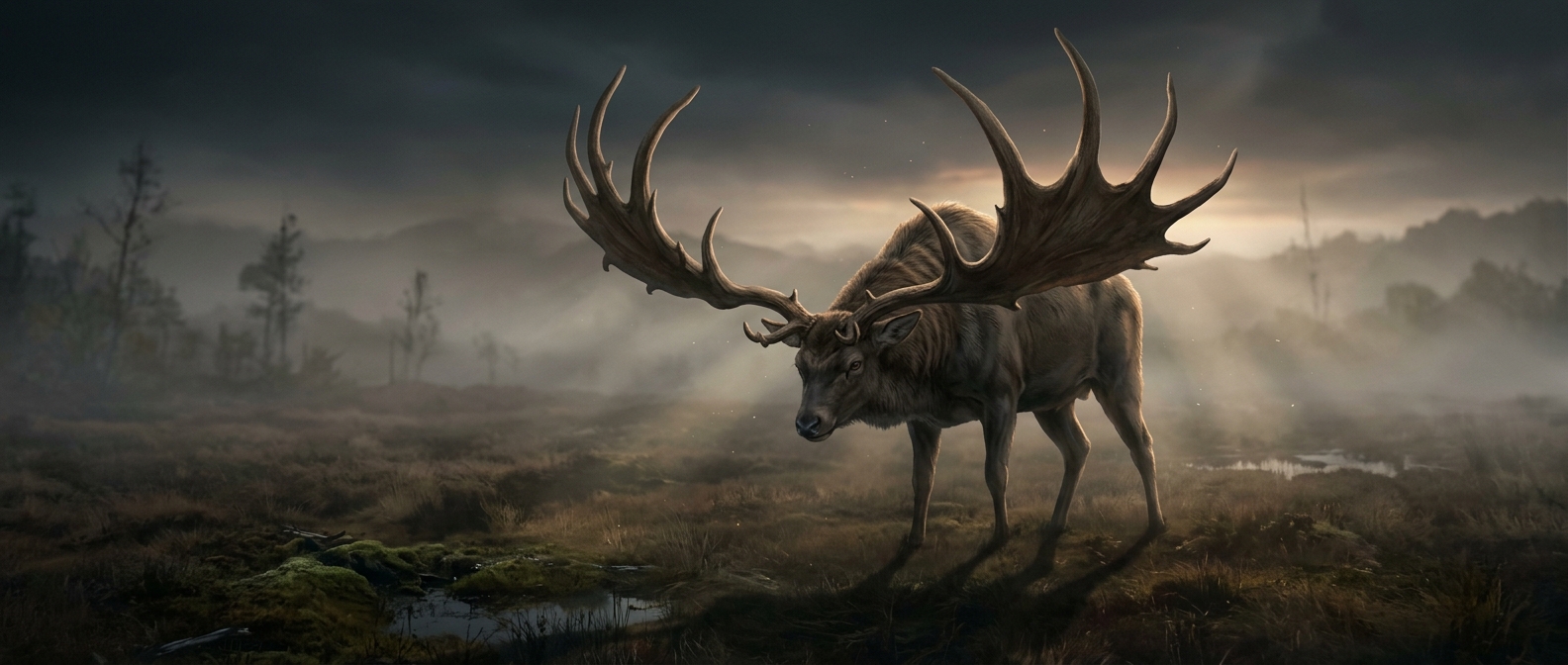
The extinct giant deer Megaloceros—often called the Irish elk, though it was not an elk—grew antlers with a span of roughly 12 feet. That width was not just an impressive outline: the antlers were large, branching structures made of bone, attached to the skull and renewed each year. Their size created a practical challenge for the animal every time it lifted or turned its head.
The Neck Had to Manage More Than Weight
A broad rack puts weight high above the shoulders and spreads it far to either side. That makes the head harder to accelerate, stop, or swing, much as a long pole is harder to maneuver than a short one. Strong neck muscles and a sturdy skull-and-neck framework would have helped support and control the antlers, but the animal still had to move through forests and feed without catching them on every obstacle.
The antlers also grew and were shed on a seasonal cycle, so their cost was not limited to carrying them. Building such a large structure required substantial resources during growth. Their elaborate branching shape is consistent with a role in displays and competition among males, although exactly how much each function mattered is difficult to establish from fossils alone.
A Display with a Built-In Tradeoff
The rack’s enormous span could make its owner conspicuous to rivals and potential mates, but it also demanded space, strength, and energy. The striking feature was therefore both an advantage in social contests and a burden the deer had to manage in ordinary movement. A 12-foot spread was not merely something to look at: it was a yearly growing structure that the animal had to carry, steer, and eventually replace.