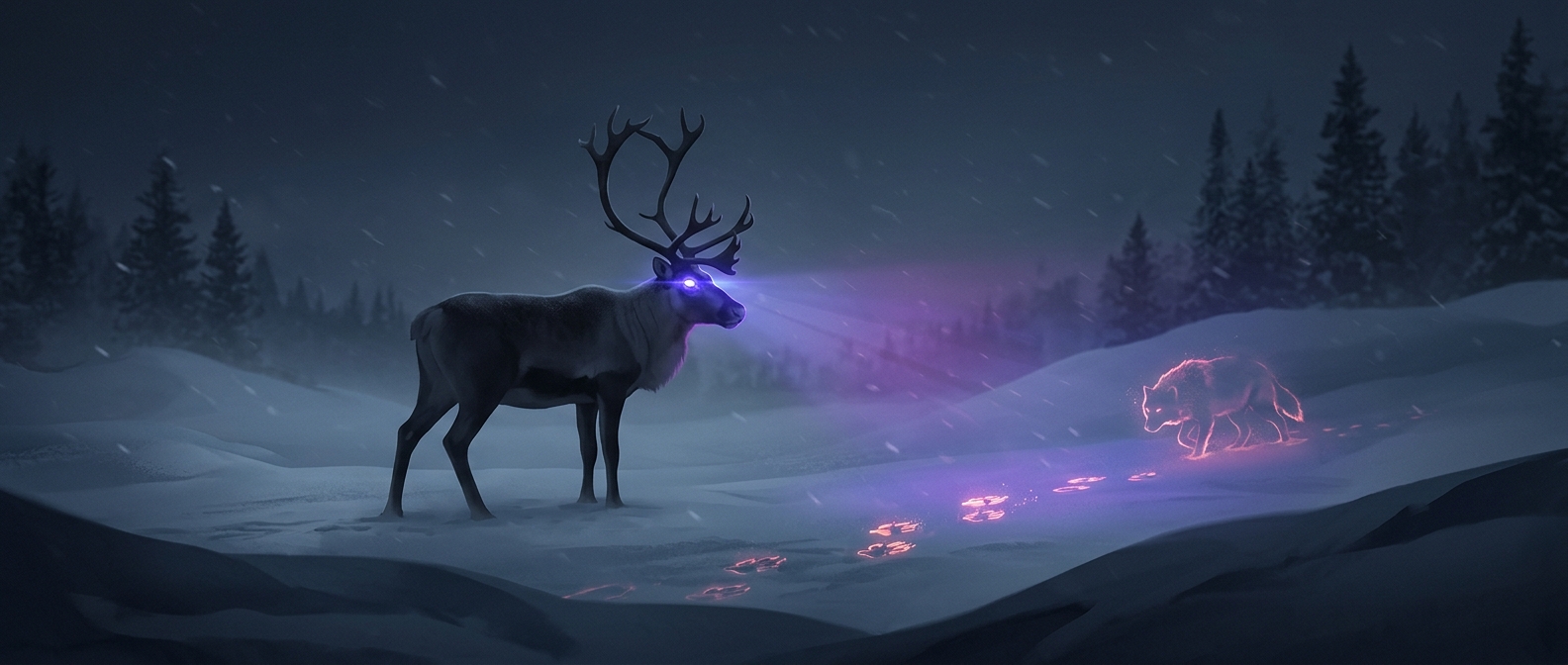
How reindeer get a second kind of contrast
Human eyes filter out most ultraviolet (UV) light before it reaches the retina. Reindeer eyes pass more of this short-wavelength light, and their retinas are sensitive to it. That does not mean the animals see a separate, glowing world: UV adds information to the patterns their eyes already detect.
In a snowy landscape, that extra information can sharpen boundaries. Snow reflects UV strongly, while some dark features—including wolf fur and many lichens—reflect less. Against the bright background, those features create stronger contrast than they may in visible light alone. A moving predator or a patch of food can therefore be easier to pick out when ordinary colors and shadows offer few clues.
Why that matters in the Arctic
Winter can flatten the landscape into pale snow, muted colors, and long periods of low light. Reindeer cannot make daylight brighter, but sensitivity to UV gives them another signal to use when distinguishing one surface from another. The advantage is not that every wolf or lichen becomes unmistakable; it is that certain shapes and patches stand out more clearly.
For people, a snowy field may look nearly blank. For a reindeer, it can contain additional visual edges—evidence written in a band of light our eyes mostly discard.