A stormy summer, and a challenge to tell ghost stories
In 1816, Mary Godwin—later known as Mary Shelley—was 18 and staying near Lake Geneva with the poet Percy Bysshe Shelley, her future husband, and a small circle that included Lord Byron. The weather was unusually wet and cold, keeping the group indoors. To pass the time, Byron proposed that each person try writing a ghost story.
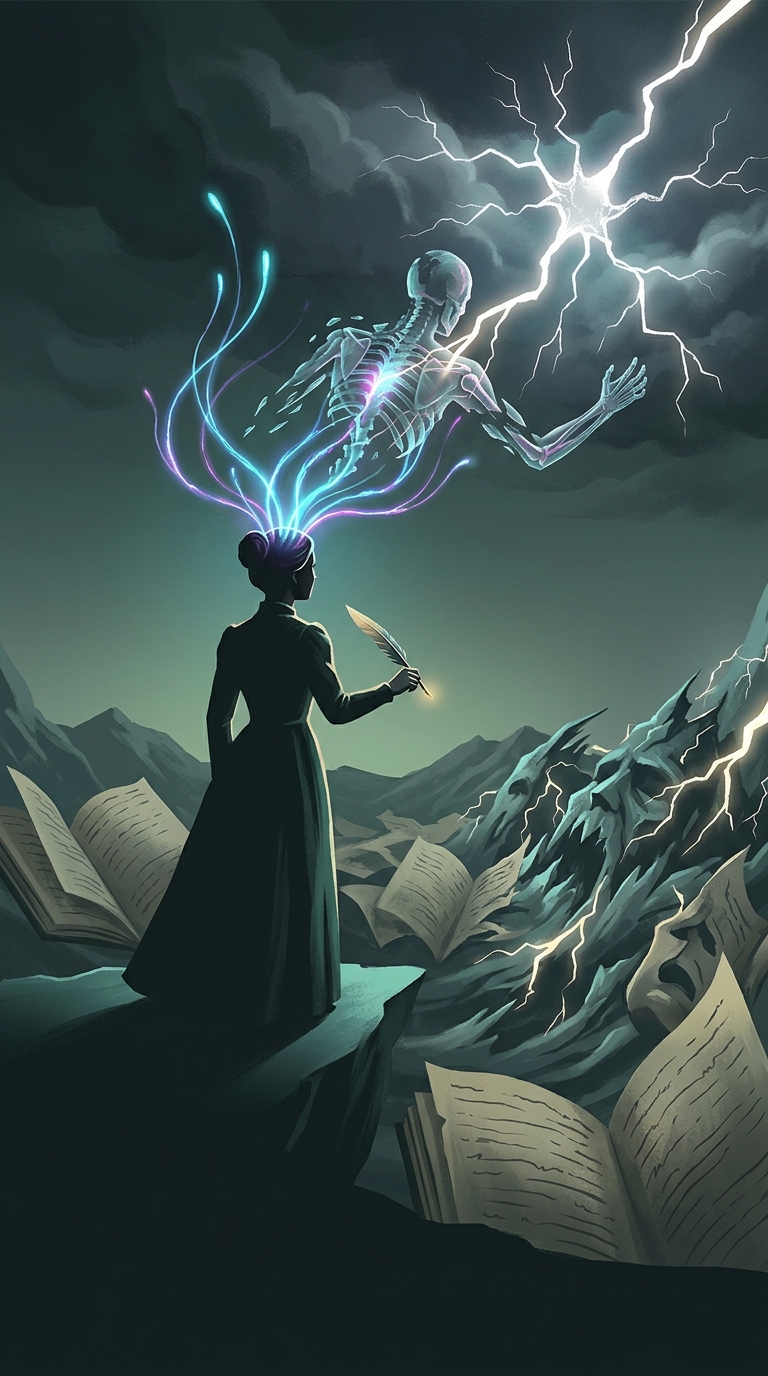
The challenge gave Mary a reason to search for an idea, but the conversation around it supplied the material. The group had been discussing whether life might be restored to matter that was no longer living. Their talk touched on contemporary experiments with galvanism, the use of electricity to make muscles twitch. It was an era when such demonstrations made the boundary between life and death feel newly open to question—not because anyone had brought the dead back, but because a lifeless body could visibly move.
From a waking vision to a novel
Mary later described the moment when the story took hold as a vivid waking vision: she imagined a student of forbidden knowledge standing over the thing he had assembled, watching it stir. The disturbing part was not simply that the creation came alive. It was the creator’s horror at seeing his work become real—and his responsibility for what followed.
That image grew beyond the ghost story exercise. Mary developed it into Frankenstein, first published anonymously in 1818. The novel turned a fashionable scientific question into a human one: if someone creates life, what does that person owe the being brought into the world? The electricity helped spark the vision; the lasting terror came from the relationship between creator and creation.