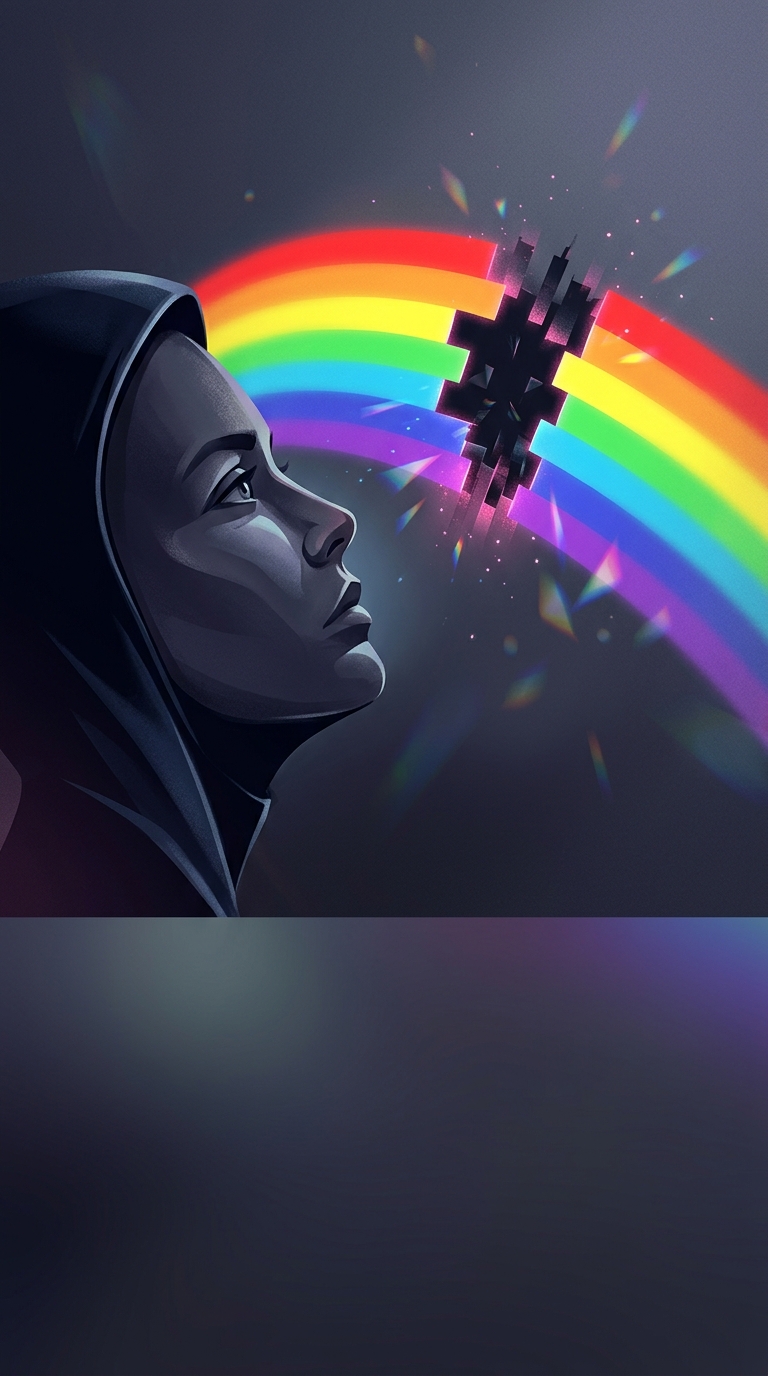
Why pink is missing from a rainbow
A rainbow spreads sunlight into colors according to wavelength, the spacing between crests of light waves. Red light has relatively long wavelengths; violet has short ones. Between them lie the colors usually named orange, yellow, green, and blue. Each band corresponds to light arriving in a particular range of wavelengths.
Pink—often called magenta when it is more vivid—has no place in that sequence because it is not produced by one wavelength. It is a color your visual system constructs from a mixture, rather than a single spectral color.
The brain fills the gap
When red and violet light reach the eye together, they stimulate different kinds of light-sensitive cells. The brain combines those signals into a color we perceive as magenta or pink. In the visible spectrum, red and violet sit at opposite ends; there is no wavelength that bridges them in the way green lies between blue and yellow.
A rainbow shows sunlight separated into its component wavelengths, so it displays the spectrum’s continuous progression rather than every color people can perceive. It cannot contain a distinct pink band, any more than a single musical note can be a chord made from two far-apart notes.
A real color, but not a spectral one
Pink is not imaginary: objects can look pink, and screens can produce it by combining red and blue light. The distinction is about the light reaching the eye. A narrow band of one wavelength can produce a spectral color; pink requires a mixture of wavelengths and the brain’s interpretation of that mixture.
So the rainbow’s omission is not a flaw in nature. It reveals that some colors describe wavelengths, while others describe how the brain combines them.