A Titan is meant to dwarf the battlefield
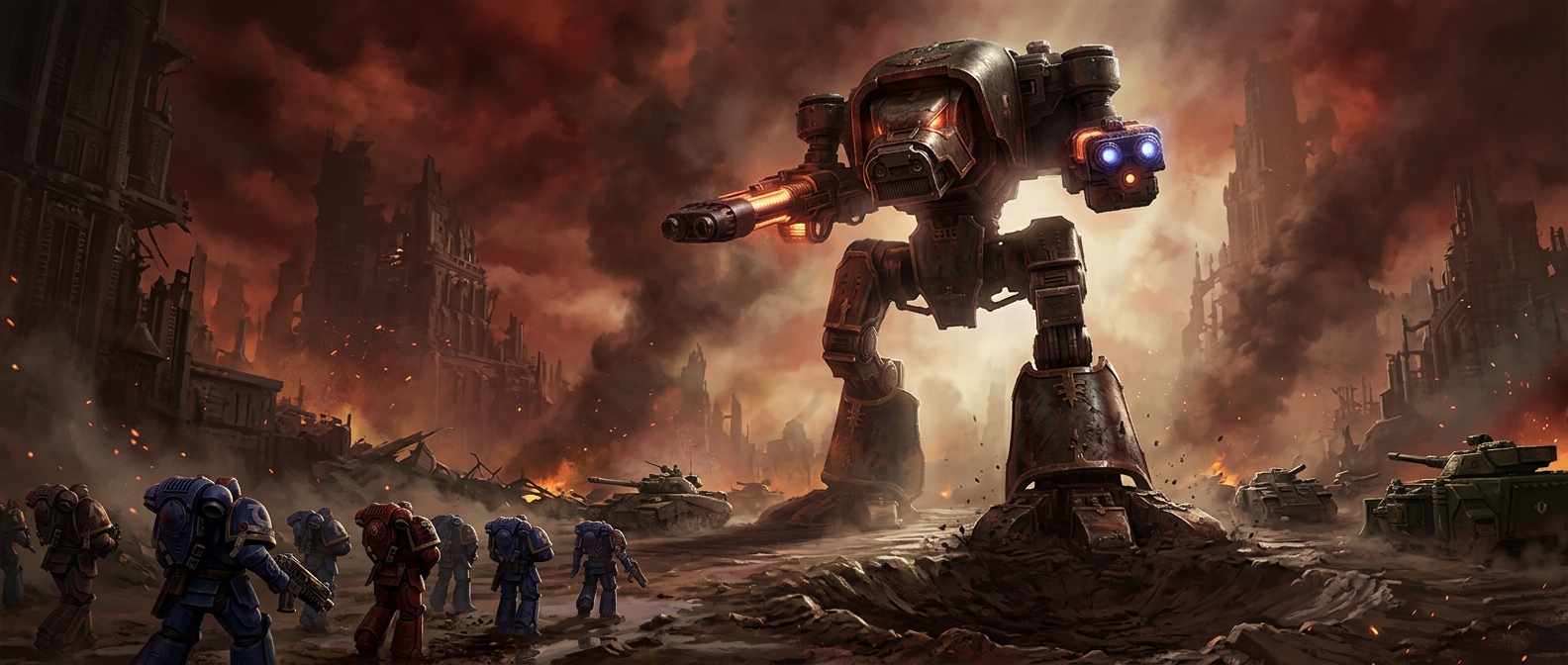
In Warhammer 40,000’s fiction, Titans are enormous walking war machines, built to carry weapons and armor on a scale ordinary troops cannot match. Putting one beside infantry makes that hierarchy instantly legible: the soldiers look tiny because, in the imagined world, they are. The model turns a piece of lore into something players can see from across the table.
The model is also a centerpiece
A Titan’s size makes it more than another unit to move among ranks of troops. It becomes a focal point for the whole game: its silhouette dominates the view, and its presence can shape how players think about the battlefield. Large resin models especially invite a display-model sensibility, with space for imposing armor and detail that would disappear on a small figure.
That visual drama comes with practical consequences. A giant model takes up table space, is harder to move and store, and can affect what players can see around it. Its physical size is not a promise that every part of the game uses perfectly consistent real-world scale; tabletop rules represent the machine through unit profiles and battlefield mechanics. The Titan’s job is to feel colossal, not to make every other model’s dimensions mathematically match it.