Why a stopped escalator still has steps
An escalator is not a flat belt that happens to carry stair-shaped bumps. Its steps are linked in a continuous chain, and rollers on each step travel through fixed guide tracks. The tracks control each step’s position: along the incline, the tread stays level and the riser stays upright, preserving the staircase shape.
At the top and bottom, the tracks curve. That guides the steps into a level landing, where they pass beneath the comb-like plates at the floor. The same guided chain that makes the steps flatten at the ends keeps them arranged as stairs through the middle.
What the motor—and brake—change
The motor pulls the step chain around the loop; it does not create the steps’ shape. If the drive stops while the steps are on the incline, a brake holds the mechanism rather than letting the loaded chain roll freely backward. The steps remain in their guided positions, so the incline can function like a stationary staircase.
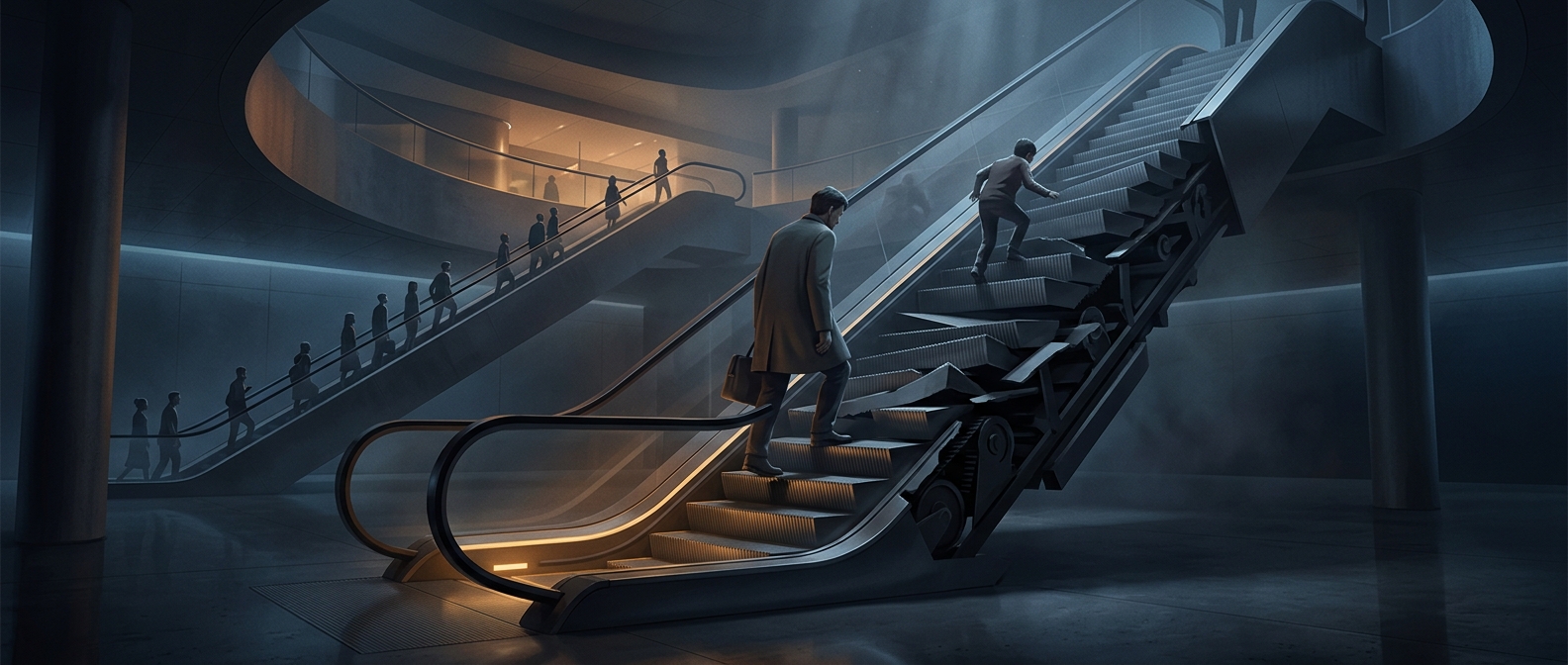
That is the useful engineering distinction: the escalator’s movement depends on power, but its stair geometry comes from its links and tracks. A stopped escalator can therefore still move people on foot—provided its steps and mechanism are intact. A fault that damages or jams those parts is a different matter; the stairs are a consequence of the escalator’s structure, not a guarantee that every out-of-service escalator is safe to climb.