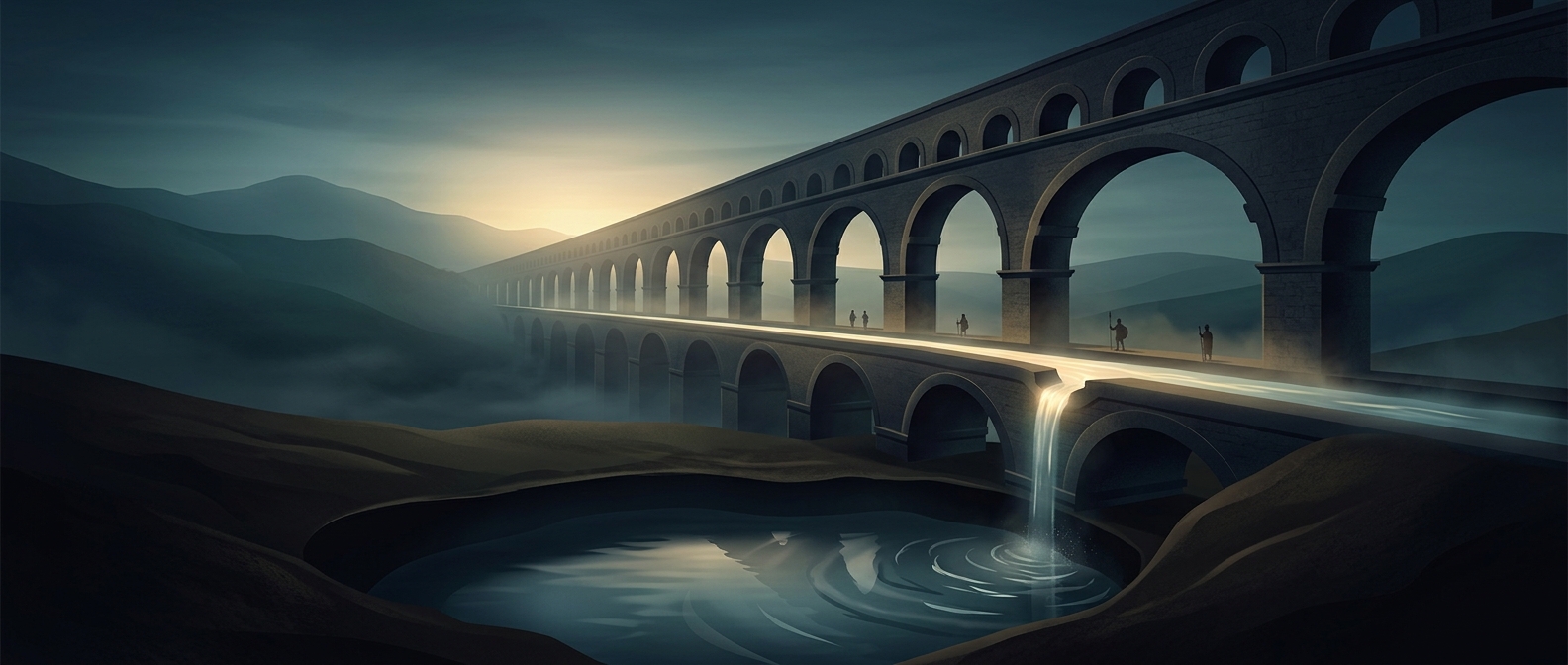
A water channel had to behave like a long, shallow ramp
An aqueduct did not push water uphill with a pump. Its channel—often a covered trough called a specus—ran gently downhill, letting gravity carry water from a spring or reservoir toward a town. The challenge was maintaining that descent over a route that could stretch for miles and cross very different terrain.
A channel that dropped too sharply would send water rushing, increasing the force against its floor and sides. A route that was nearly level, or dipped into low spots, could slow the flow enough for sediment to settle and obstruct it. Roman builders therefore had to balance steady movement against wear and blockage, rather than simply choose the shortest path.
The route mattered as much as the arches
Aqueducts are often pictured as rows of arches, but those structures were only one way to keep a channel at the right height. Where possible, water traveled through tunnels cut into hills or along a slope; arches carried it across valleys when the ground fell away. Each change in terrain forced engineers to preserve the channel’s overall downhill course.
That meant surveying the route and adjusting it to the landscape. A longer path around a hill could be preferable to a dramatic plunge, because the goal was not merely to get water to the city—it was to deliver it at a reliable flow and elevation. The visible arches were thus part of a larger system whose most important feature was often hidden: a carefully controlled gradient.
Gravity set the terms of the job
Once water entered the channel, gravity did the daily work, but it also imposed the engineering constraint. The aqueduct’s route, slope, and construction had to cooperate over its full length; a local dip or overly steep stretch could undermine the performance of the whole supply. That is why Roman aqueducts were feats of measurement as much as masonry: their success depended on making a barely noticeable descent continue, mile after mile.