A Cow Was Not an Intruder in Ramana’s Room
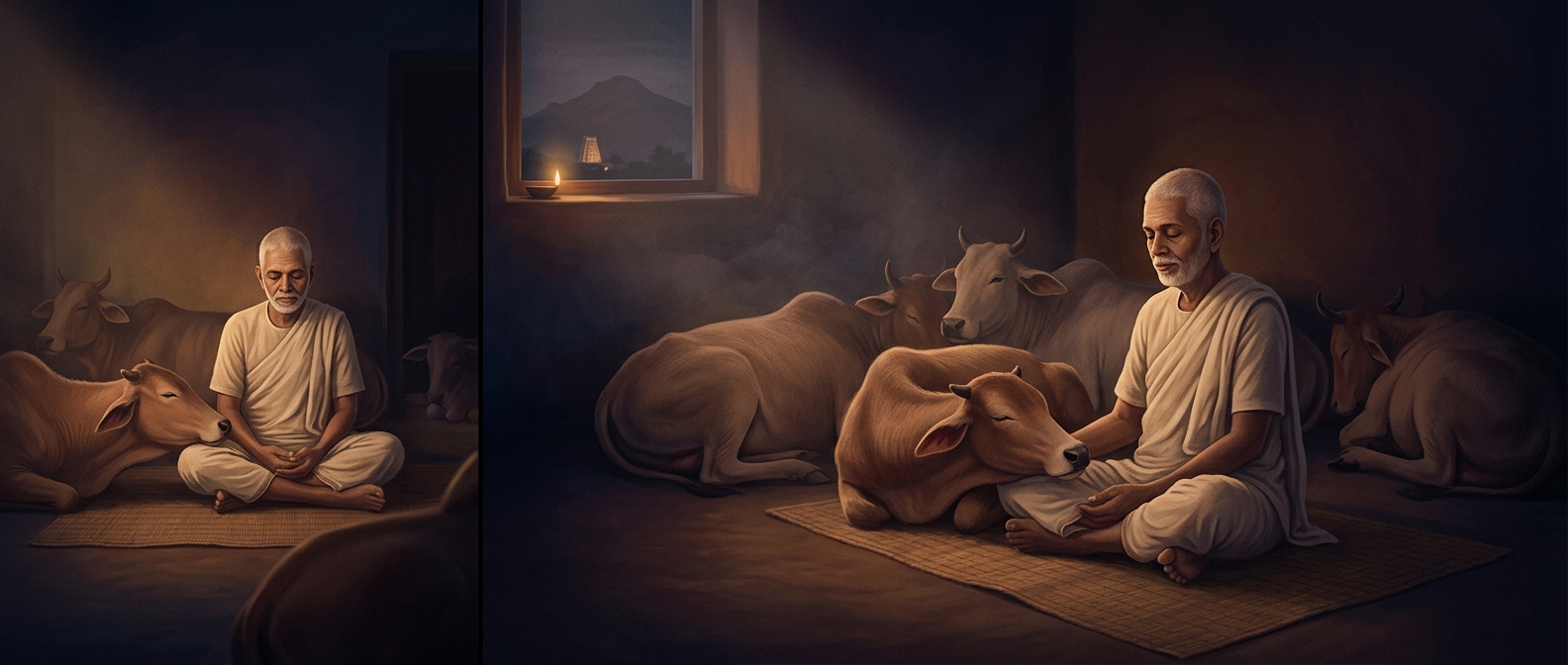
For Ramana Maharshi, a cow entering his living quarters did not necessarily call for the usual human response: shooing it away or treating it as a nuisance. His willingness to let Lakshmi settle beside him reflected a broader way of seeing animals—not merely as possessions or useful creatures, but as beings worthy of the same basic regard as people.
That attitude fits the nondual teaching associated with Ramana. Nonduality means that the deepest reality is not divided into separate, self-contained beings. From that perspective, treating an animal with patience was more than an act of affection; it was consistent with questioning the boundary between “me” and “other.”
What the Ordinary Scene Made Visible
The striking part is how little ceremony the story requires. A cow could cross into the space where Ramana lived and rest near him. There was no special performance to signal reverence: the animal’s presence was simply allowed. In that small domestic moment, a spiritual idea became practical—an animal’s comfort mattered enough not to be interrupted for the sake of human convenience.
This did not mean that a cow and a person had identical needs or roles. It meant that spiritual worth was not reserved for human beings. Lakshmi’s place beside Ramana made that conviction tangible: equality, in this sense, showed up as a cow being permitted to rest undisturbed.