Why a Leaking Bowl Could Measure Time
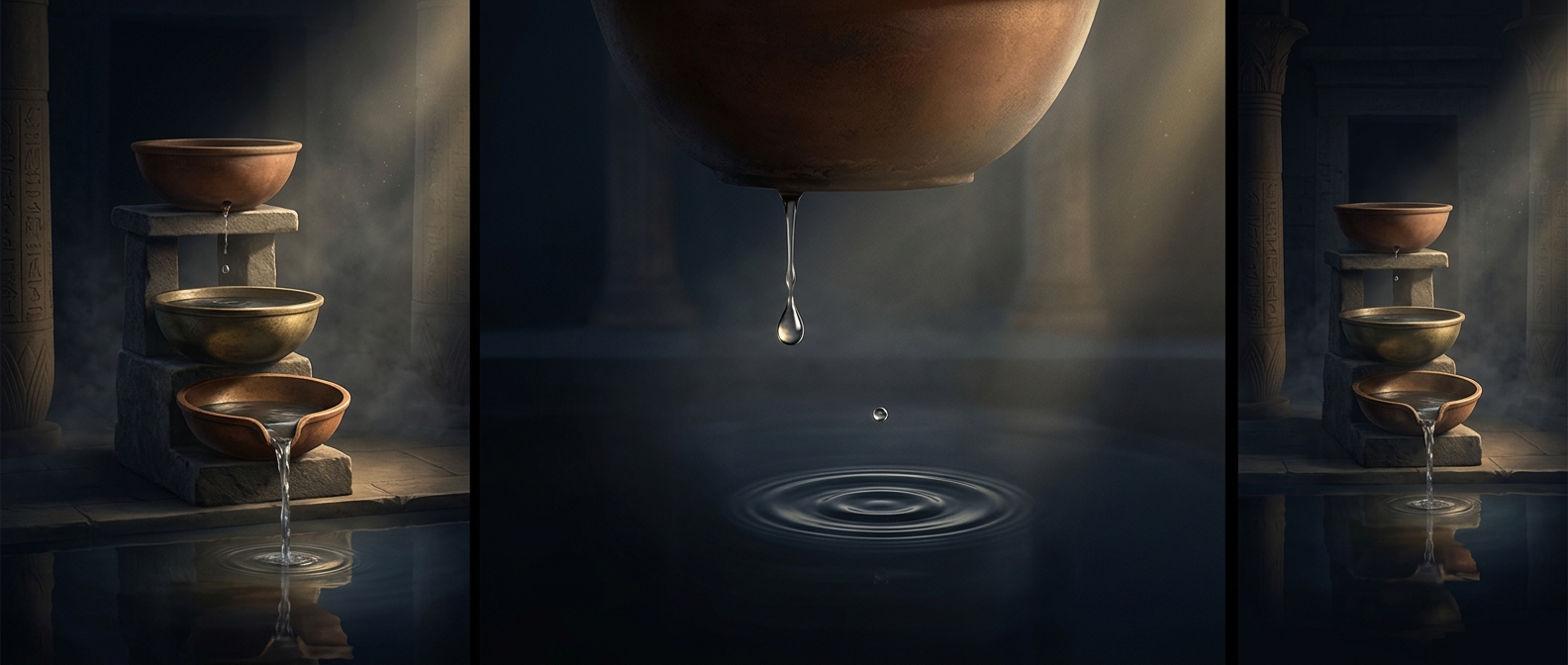
A water clock turned a slow change in water level into a record of elapsed time. In a simple design, water escaped through a small opening in a vessel, while marks inside showed how far the level had fallen. The marks had to be calibrated: they were not simply equal lines for equal hours.
That is because water does not drain at a perfectly steady rate. When the vessel is full, the weight of the water pushes harder through the opening; as the level drops, that pressure weakens and the flow slows. A clockmaker could account for this by spacing the marks unevenly, giving the falling level more distance to cover as the leak slowed. The vessel’s shape also affected how quickly the level changed.
A Clock That Needed Its Conditions
A water clock did not depend on the Sun, so it could track time indoors or after dark, when a sundial could not. But it was less like a modern clock that keeps running at one fixed pace and more like a carefully calibrated measuring instrument. Its accuracy depended on the size of the opening, the vessel’s shape, and the behavior of the water.
Temperature could matter, too: colder water is more viscous—thicker and more resistant to flowing—so it may drain differently. A clock might therefore need adjustment or calibration for its conditions. Its basic achievement was modest but striking: by shaping a container and measuring a leak, people made time visible as a changing waterline.