Why a crossing cannot be treated like an ordinary junction
A road crossing works only if people and vehicles can reliably stay clear of the rails. At high speed, that assumption is too fragile: a train covers ground quickly, and its brakes cannot bring it to a stop in the short space available to a driver who spots trouble at a crossing. Warning lights and gates can reduce risk, but they cannot prevent every vehicle from getting trapped, stalled, or driving around a barrier.
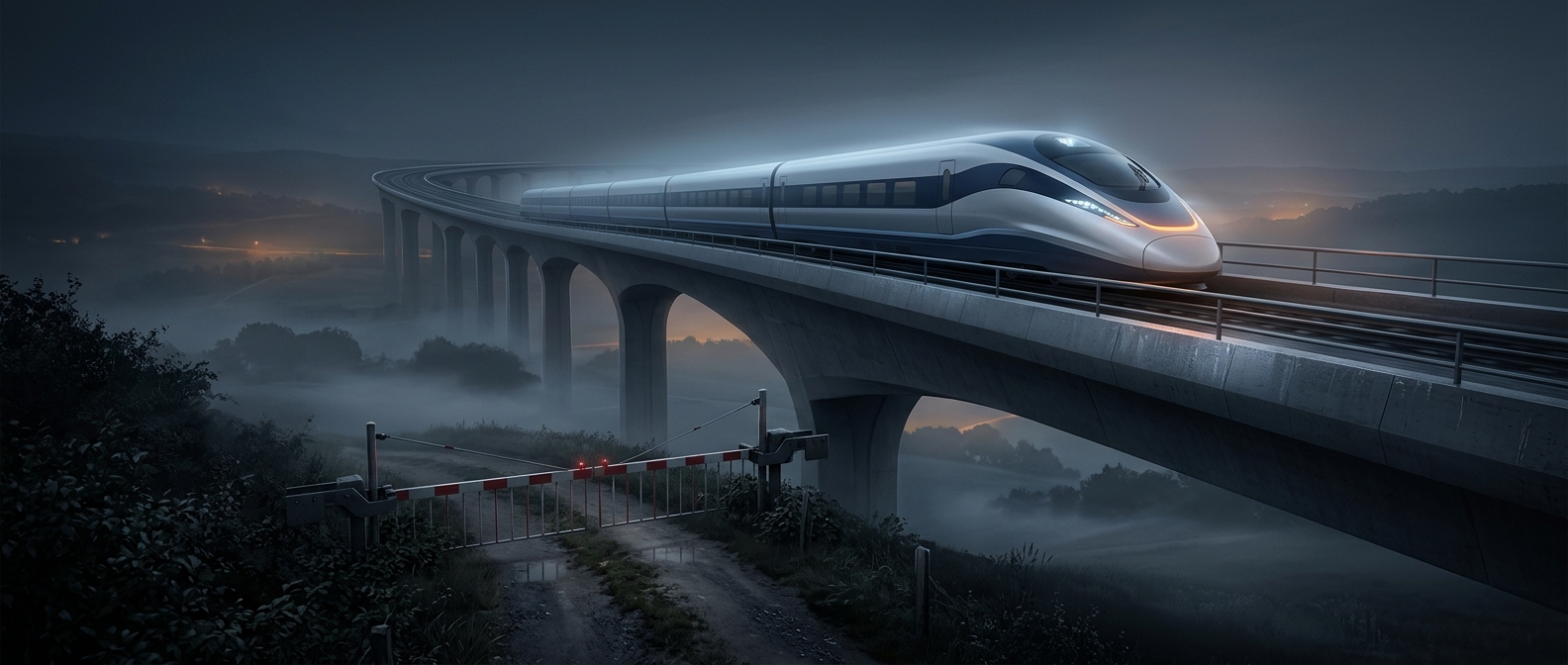
The safer design is to remove the conflict altogether. A level crossing is a place where a road and railway intersect at the same height. High-speed routes instead pass roads over or under the tracks, so neither stream of traffic has to wait for, judge, or yield to the other.
The safety choice shapes the whole route
Grade separation—putting the road and railway on different levels—sounds like a local fix, but it affects the railway’s layout. A bridge needs room for ramps leading up to it; a tunnel needs excavation, drainage, and careful management of water and soil. Where the terrain or existing development leaves little room, designers may have to alter the railway’s alignment or build a more complex structure.
That extra construction buys more than protection at a single road. With no crossing gates to lower and raise, trains can pass without interrupting road traffic, and the railway avoids a point where a collision or blocked track could halt service. The tradeoff is visible in the landscape: a high-speed line may require more bridges, tunnels, and embankments, but those structures let the train run through the route without asking anyone to gamble on a shared intersection.