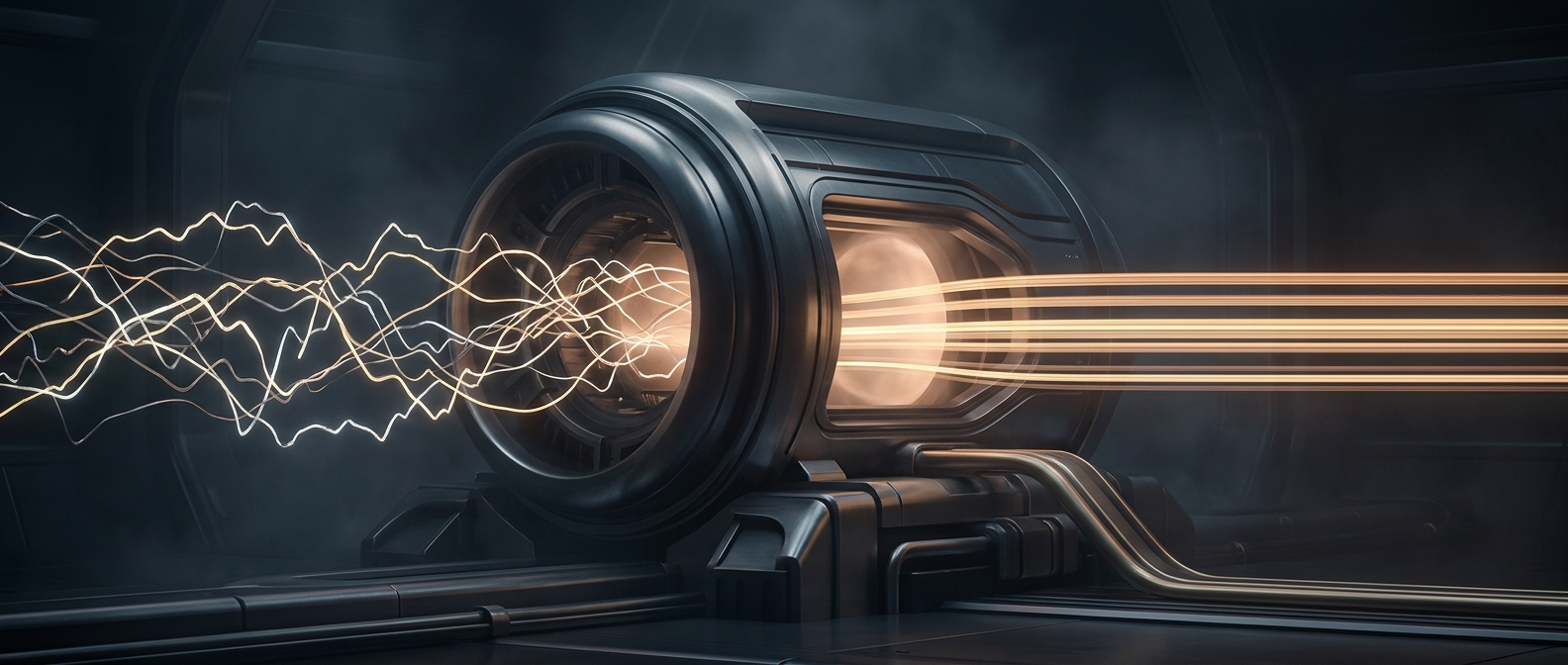
From a reversing waveform to usable power
Wall power does not flow in one direction continuously: alternating current (AC) repeatedly reverses direction. Computer chips and most other internal components instead run on direct current (DC), which flows in one direction at controlled voltages. A power supply has to do more than simply change the shape of the electricity; it must deliver several stable outputs as the computer’s workload changes.
The conversion happens in stages
In a typical modern computer power supply, the incoming AC first passes through circuitry that limits electrical interference and rectifies the current. Rectification uses electronic components called diodes to make current flow in only one direction. The result is still uneven, so capacitors—components that briefly store electrical charge—help smooth the fluctuations.
Most modern units then switch that electricity on and off very rapidly and use a small transformer to adjust its voltage. Switching at high frequency allows the transformer to be much smaller than the heavy transformer that would be needed at the outlet’s frequency. Feedback circuitry monitors the outputs and adjusts the switching to keep them near their intended levels, even as components draw more or less power.
Why stability matters
A processor may change its power demand in moments as it moves between idle and demanding work. The supply must respond without letting its output drift enough to disrupt the computer. It also provides protections that can shut down or limit output during certain faults, such as excessive current or voltage.
The practical result is that a desktop’s large power-supply box is not merely an adapter. It is a compact conversion and control system: it turns one fluctuating input into several regulated DC outputs that different parts of the computer can use.