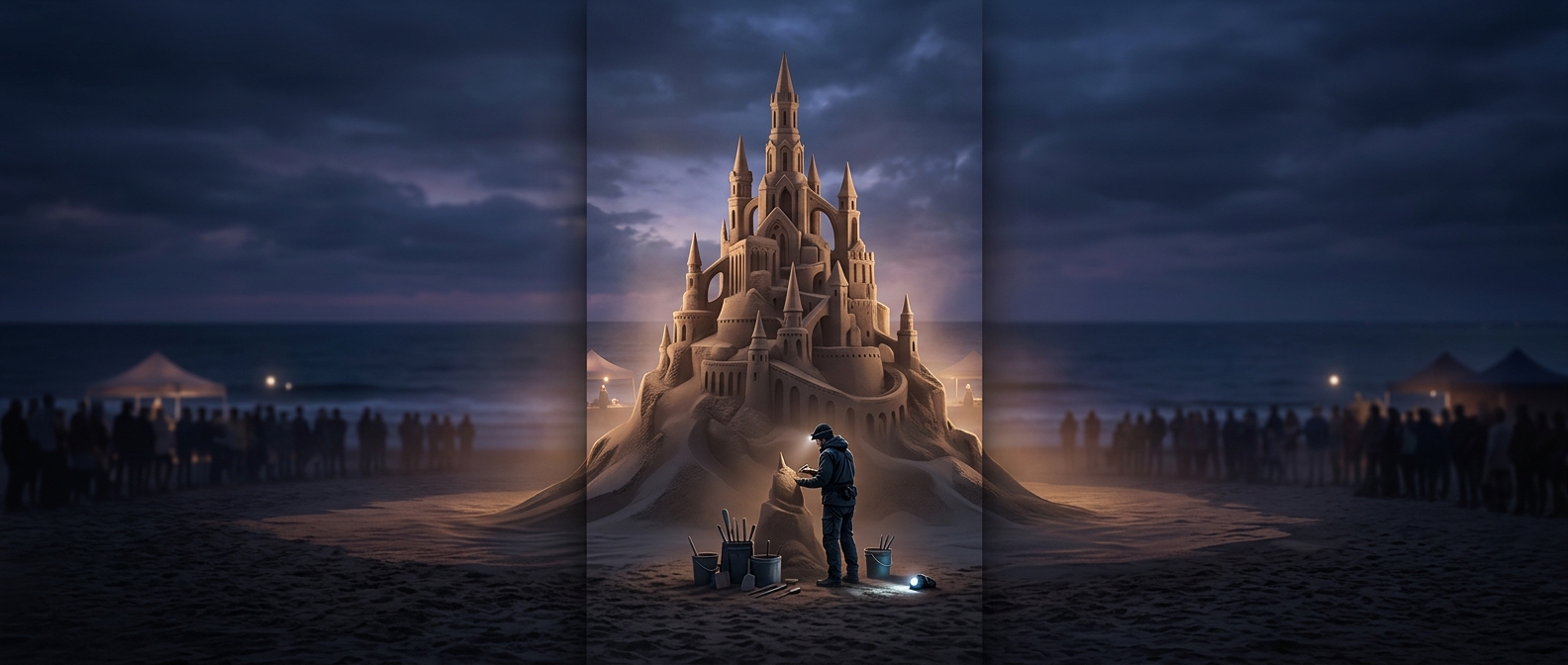
Why Wet Sand Can Hold a Shape
A sand sculpture is not held together by glue. A thin film of water forms tiny bridges between grains, and surface tension pulls those grains toward one another. With the right amount of moisture and firm packing, sand can behave less like loose beach material and more like a temporary building medium.
Too little water leaves the grains sliding apart; too much lets water flow between them and weakens the packed structure. Sculptors therefore have to manage the material as they work, not just choose a design. The sand itself matters, too: grains that pack closely can make a more stable mass for carving.
Build the Mass, Then Reveal the Design
The work often begins with a large, compacted block. Packing gives the sculpture a solid core; carving then removes material to expose figures, folds, and fine details. That sequence shapes the design: a narrow projection or delicate feature must be planned around the strength of the sand beneath it, because there is no easy way to replace a chunk that breaks away.
Tools help control the scale of the cuts, from broad shaping to small surface details. But technique cannot eliminate the material’s limits. Sculptors must balance visual ambition against gravity, drying, and the risk that a thin section will crumble before the piece is finished.
The Deadline Is Part of the Medium
Unlike a stone carving, a sand sculpture has no durable finished state. Wind and changing moisture can alter it, and the tide eventually takes it apart. That makes the event’s achievement unusually time-bound: the finished work is meant to be judged and seen while its temporary structure still holds.
The disappearing act is not a flaw in the craft. It is the final constraint. Every elaborate tower or carved face is made from a material that gives its maker only a brief window to turn packed grains into a coherent image.