How cosmic rays become radiation inside an aircraft
Cosmic rays are energetic particles arriving from space, including particles produced by the Sun and by sources beyond our solar system. When they strike the upper atmosphere, they collide with air molecules and create cascades of secondary particles. Some of those particles continue downward far enough to reach aircraft altitude and pass through the cabin, adding a small amount of ionizing radiation—the kind that can alter atoms in living tissue.
A plane does not shield passengers completely. Its metal structure blocks some radiation, but many of the particles involved can penetrate it. The atmosphere remains the main protection, which is why flying higher changes exposure.
Why routes and flight time matter
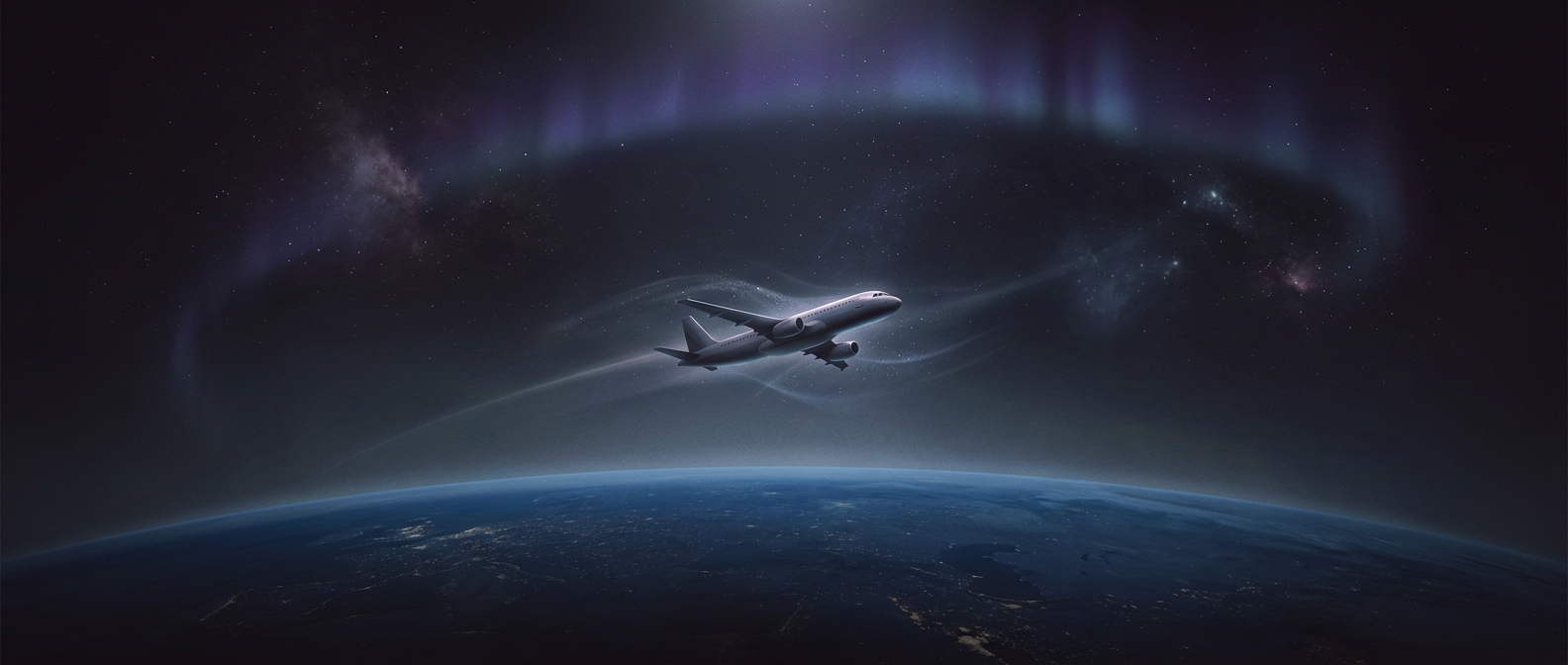
The amount a person receives is not the same on every trip. Longer time in the air generally means more exposure, and altitude matters because the protective atmosphere is thinner higher up. Earth’s magnetic field also deflects some incoming charged particles; its protection is weaker near the poles than near the equator. As a result, a high-latitude route can expose travelers to more radiation than a comparable flight farther south.
Solar activity can change the particle environment too, although its effects vary. These factors combine, so a single number cannot describe every flight.
The tradeoff is managed, not eliminated
For an occasional passenger, the added exposure from flying is generally small. For flight crews, who may spend many hours at altitude over the course of a career, cumulative exposure is more relevant, and aviation authorities and employers can use estimates of route, altitude, and time aloft to assess it.
The practical point is not that flying is unusually dangerous: it is that the cabin sits in a different radiation environment from the ground. A polar route or a long flight can make that difference more noticeable, even though the atmosphere still provides substantial protection.