How Chinese Opera Turns Sleeves Into Stagecraft
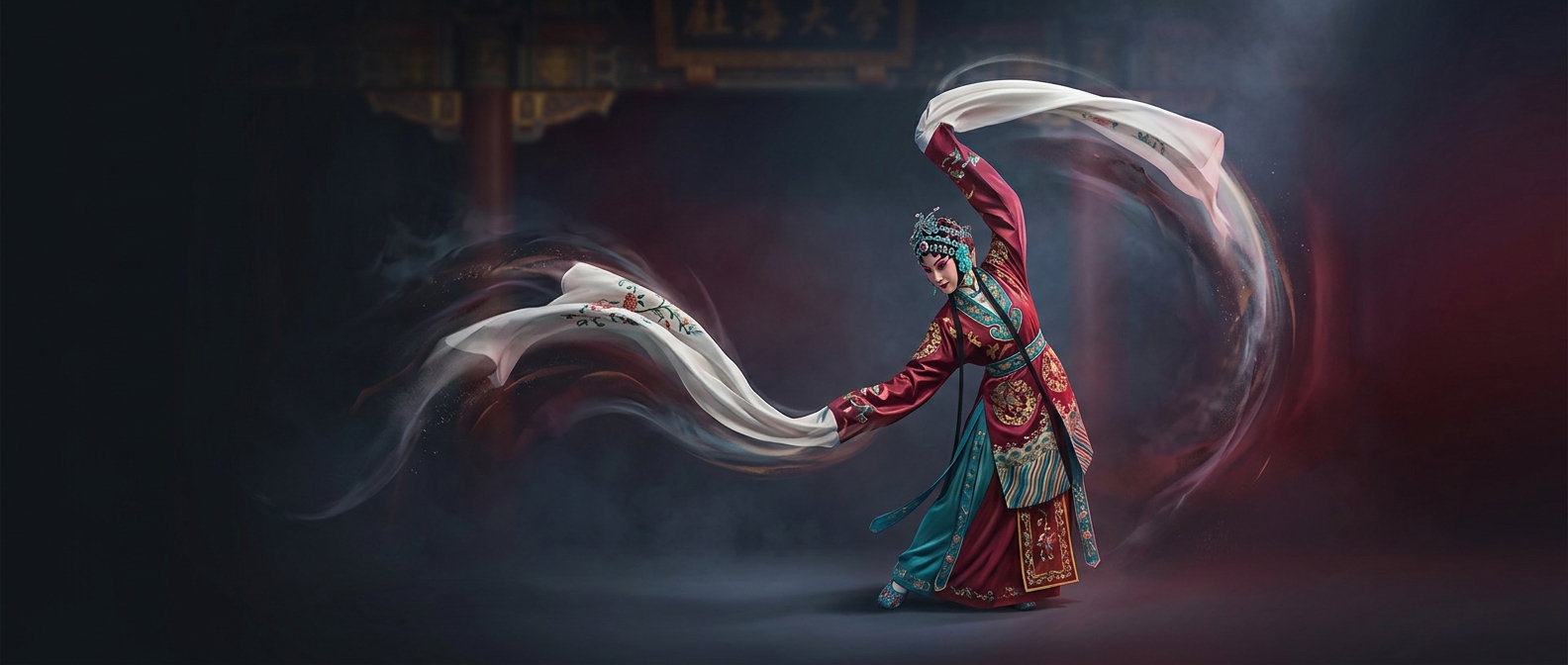
In many forms of Chinese opera, the long white extensions attached to a costume’s sleeves—often called water sleeves—are not simply extra fabric. They enlarge the performer’s movements, making a hand gesture visible across the stage. A small turn of the wrist can send the cloth curling outward; a sudden stop can leave it hanging in a clear, deliberate shape.
A Gesture Has a Beginning and an Afterimage
The sleeve does not move by itself. Performers coordinate the wrist, elbow, shoulder, and torso so the fabric follows, trails, or snaps into place. That delay gives a gesture two parts: the performer’s motion and the sleeve’s lingering response. Repeating, circling, or sharply checking the movement can shape its force and rhythm, much as a musical phrase uses pauses as well as notes.
Because the cloth magnifies motion, control matters. An uncontrolled sweep can obscure the face or disrupt the next movement; a precise one can direct attention without changing the scenery. The sleeve becomes part of the actor’s expressive vocabulary, alongside posture, steps, gaze, and facial expression.
A Visual Language for a Distant Audience
The same length of fabric can communicate differently depending on how it is handled and what is happening in the scene. Drawn across the face, it can make concealment itself readable; cast outward, it can turn an emotion into a bold stage image. These are conventions, not fixed translations: context and performance determine what a gesture means.
That is the practical brilliance of the water sleeve. It lets a performer project an inner state through a simple, visible action—so even a flick of cloth can carry the scene’s emotional weight.