A bomb aimed by counting its own flight
The Kettering Bug was an early attempt to make an aircraft deliver explosives without a pilot. Its designers faced a problem that sounds simple only after the fact: how could a machine travel a chosen distance and then dive on a target without radio control, cameras, or a pilot to correct its course?
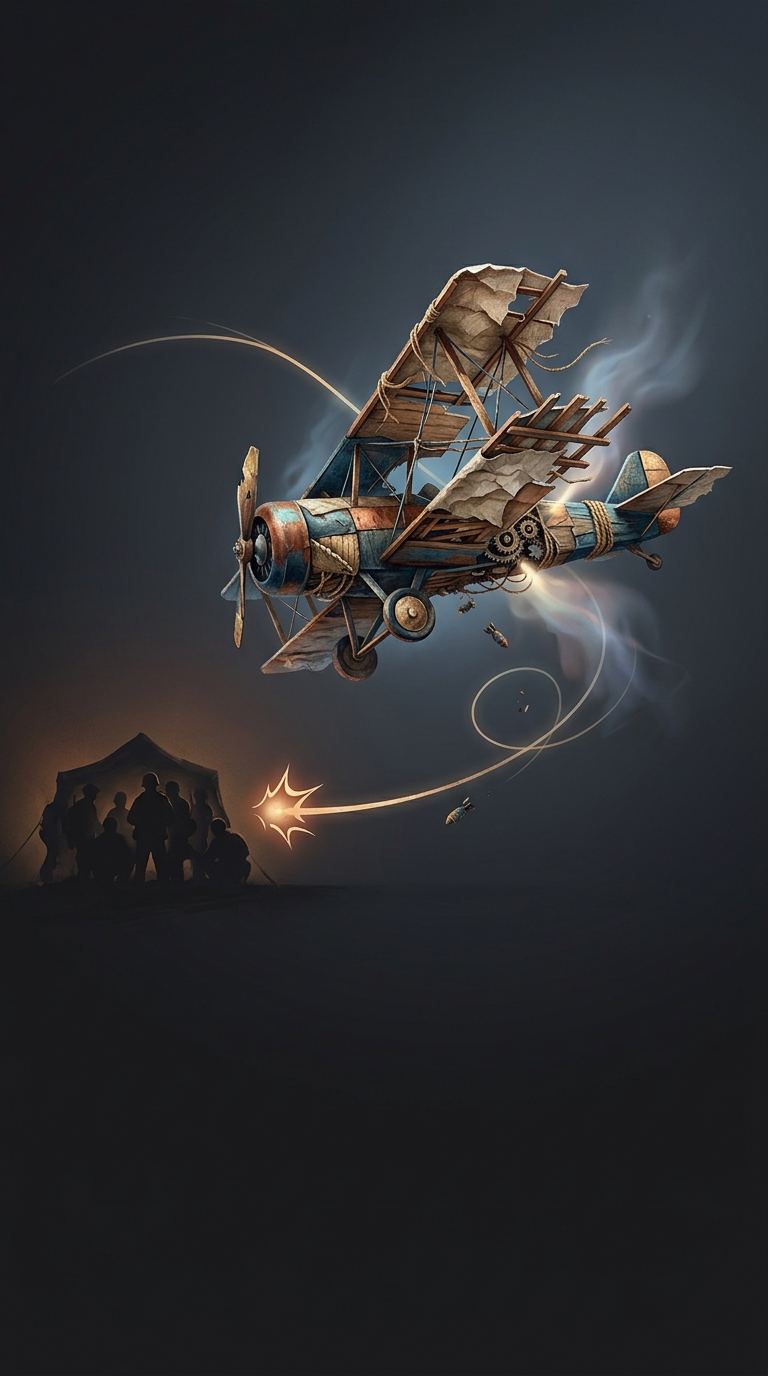
Their answer was to make the Bug follow a preset recipe. Before launch, its operators calculated how many engine revolutions should roughly correspond to the intended distance. A revolution counter tracked those turns in flight. When it reached the preset count, the engine stopped and the wings were released, sending the bomb-laden body downward. A gyroscope—a spinning device that resists changes in direction—helped keep the aircraft stable on its way there.
Distance was not the same as accuracy
This was a range-setting mechanism, not a way to see or recognize a target. Once launched, the Bug could not respond to changing winds or steer around an error. Its operators had to set the machine’s course and estimate its travel before takeoff; the counter could tell it when to begin its dive, but not whether it was over the right trench.
That distinction explains both the ingenuity and the limitation of the design. A lightweight, cheaply built airframe could carry an explosive farther than a soldier could throw one, while a mechanical counter replaced the need for a human pilot. But even a small error in estimating the flight could leave the weapon short of its target—or send it beyond it.
The war ended before the test became a weapon
The Bug was developed and tested near the end of World War I, but the armistice came before it entered combat. Its failures and unfinished state were not the whole story: the project had demonstrated a practical idea, that an aircraft could be built to fly a preset route and release itself from control at a chosen point.
The striking part is how literal that idea was. The Bug did not “find” an enemy position. It counted its way toward a place its operators had already guessed, then made its dive whether the guess was right or not.