One species, several different harvests
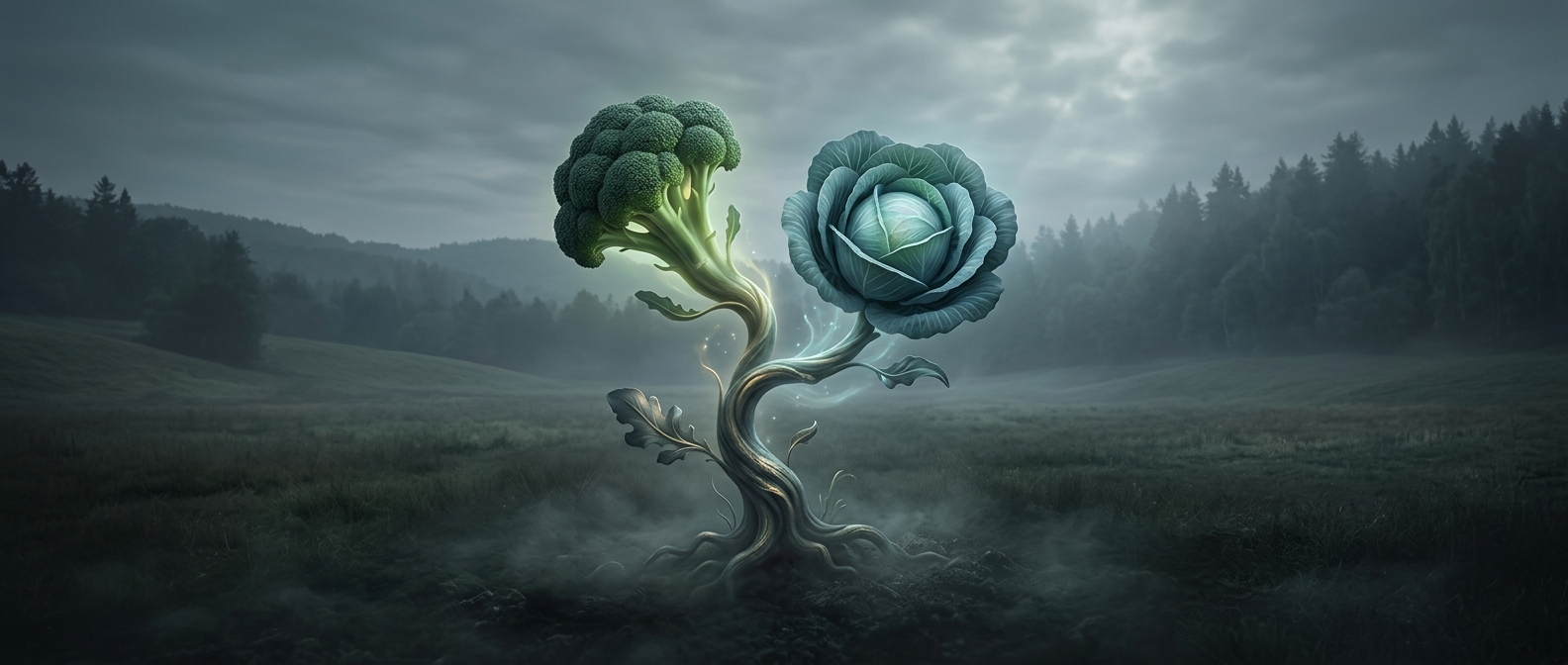
Broccoli, cabbage, kale, cauliflower, and Brussels sprouts are cultivated forms of the same species, Brassica oleracea. Their differences reflect which parts of the plant people favored over many generations—not a series of unrelated wild ancestors.
The process is called selective breeding. A plant population naturally varies: one may have broader leaves, another a thicker stem, another larger flower buds. Farmers saved seeds from plants with useful or appealing traits. Because those traits could be inherited, repeating that choice gradually shifted what the crop looked like.
Selection redirected the plant’s growth
Each familiar vegetable emphasizes a different feature. Cabbage breeders favored tightly packed leaves that form a dense head; kale growers selected for abundant leaves. Broccoli was shaped around its clustered flower buds and stems, while cauliflower’s edible head consists of compact, undeveloped flowering structures. Brussels sprouts were selected for the small buds that form along the main stalk.
These are not transformations a farmer makes in a single season. A seed does not turn into a cabbage because someone wants it to. Instead, each generation offers variation, and saving seeds from particular plants makes those traits more common in later generations. Over time, repeated choices can produce strikingly different crops from the same species.
A living record of human choices
Selective breeding works with inherited variation rather than designing a plant from scratch. Farmers’ preferences—such as a larger edible part, a denser head, or more harvestable leaves—helped steer the plant’s development. The result is a botanical family whose members look so distinct that their shared ancestry can be easy to miss: the vegetable aisle displays different outcomes of the same long process of choosing what to grow next.