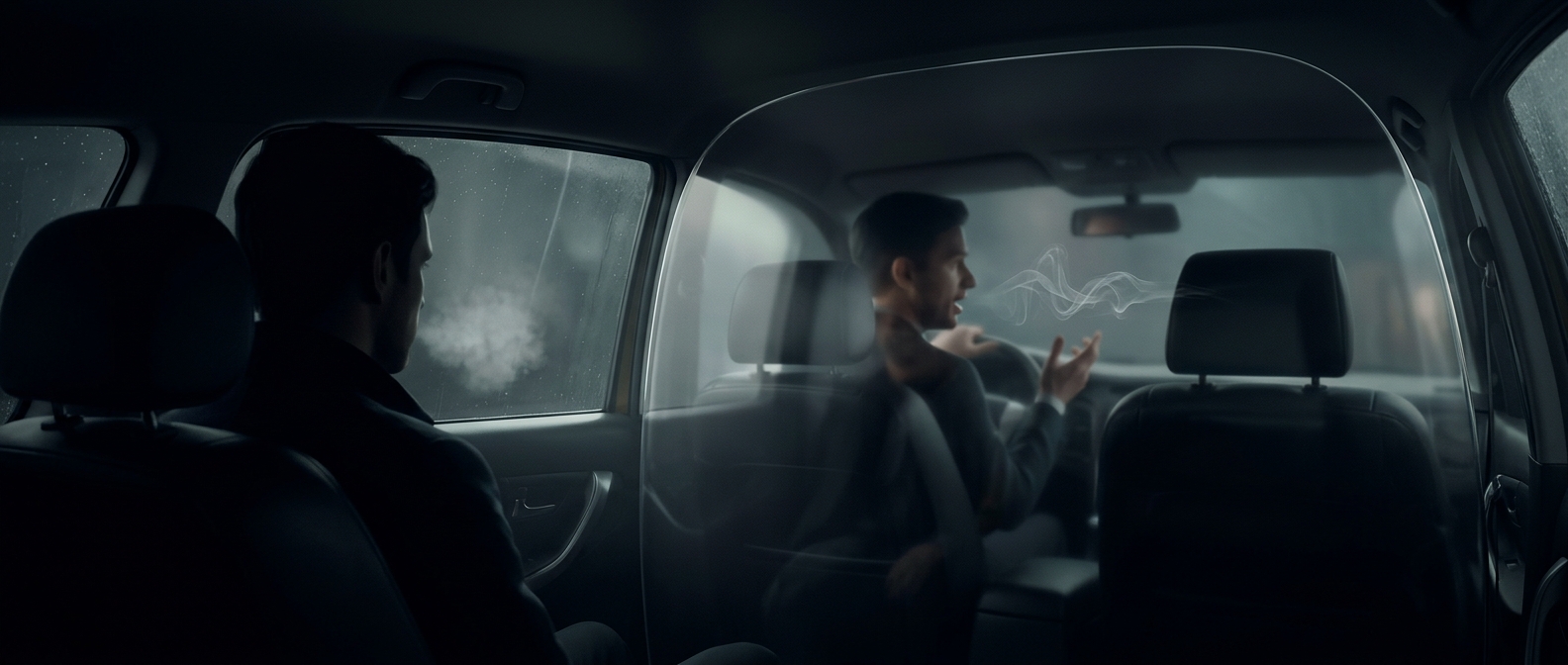
Why a Taxi Partition Swallows Speech
A thick, bullet-resistant panel changes the cab from one shared space into two partly separated ones. The driver’s voice no longer travels directly to the passenger: the panel blocks much of the sound, while its frame and the surrounding cabin can leave few clear paths for speech to pass through. Ordinary conversation may become muffled, even when the driver is only a few feet away.
Speech is especially hard to understand when its sharper sounds are weakened. Those quick consonants help distinguish words such as street names, so a passenger might hear the rhythm of an answer but miss the crucial syllables. Road noise and the engine make that gap harder to bridge.
The Coin Slot Becomes a Speaking Channel
A small opening lets people exchange payment or other items without removing the barrier. It also gives sound a narrow route between the two sides—but not the open, face-to-face path people rely on in an ordinary conversation. Turning toward the slot and speaking clearly can help; raising one’s voice may be necessary.
That makes confirming a destination a practical part of the ride, not just a formality. A passenger who assumes the driver heard a street name may discover the misunderstanding only after the cab has passed the turn. The partition’s safety function can therefore reshape a tiny routine: destination checks sometimes have to be repeated through the opening.