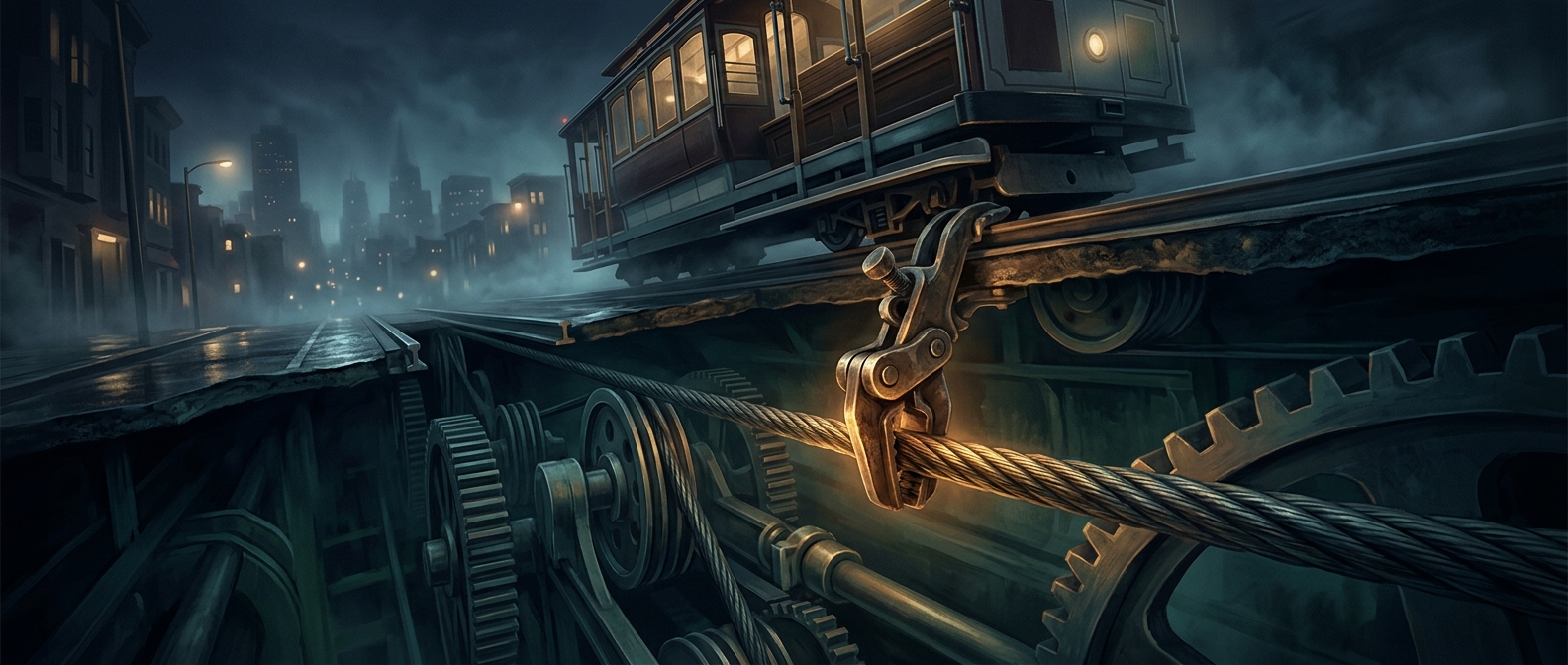
The Grip Turns a Streetcar Into a Moving-Rope Machine
A cable car has no motor aboard to drive its wheels. Instead, a powerful motor in a cable-power house keeps a steel cable circulating beneath the street. The cable travels inside a narrow conduit, with a slot in the pavement that lets a long handle—the grip—reach down to it.
When the grip operator squeezes the handle, jaws close around the moving cable. Friction between the jaws and cable pulls the car forward. The cable itself keeps moving at a steady pace; the operator controls the car by taking hold or letting go, rather than by varying an onboard engine’s speed.
Letting Go Is Part of Driving
To stop, the operator releases the cable. The car then coasts briefly before its brakes bring it to a halt. That makes the grip as much a control device as a connection: it must clamp firmly enough to haul the car up a hill, yet release cleanly at a stop or when the route requires it.
The operator also has to coordinate the grip with the track. At intersections, cables for different lines cross beneath the pavement. The car must release one cable and pass over the crossing before catching the next, all while moving through ordinary street traffic. The visible lever therefore controls a hidden, precisely timed handoff.
A Street Built Around the Cable
The cable’s path is fixed below the rails, so the system depends on extensive infrastructure: conduits, cables, machinery to keep them moving, and access points for maintenance. That arrangement gives the cars their distinctive ability to climb steep streets without carrying their own propulsion system. It also means a cable car’s journey is inseparable from the machinery under the street: the car moves only when its grip makes contact with the right moving cable.