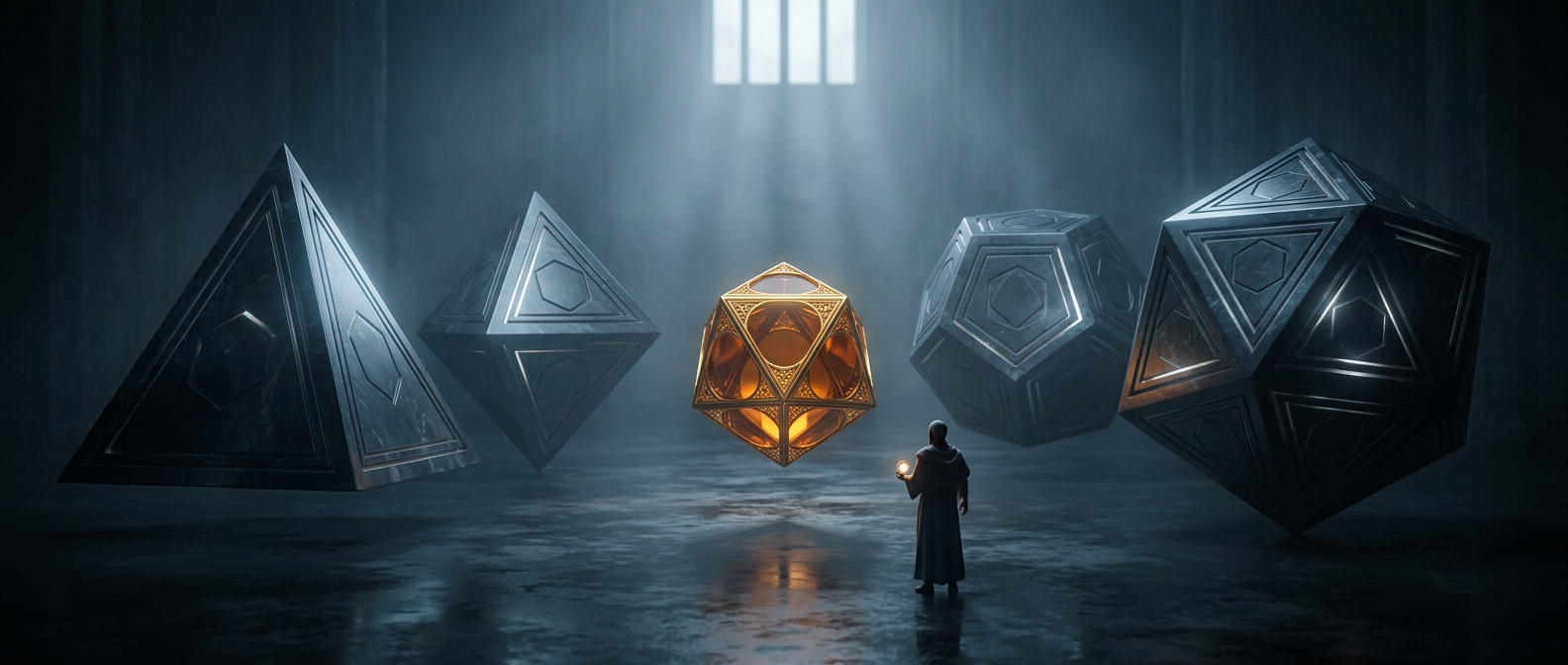
Why a ten-sided die needs a different shape
A Platonic solid is more than a solid with several faces: every face must be the same regular polygon, and the same number of faces must meet at every corner. There are only five shapes that meet those conditions: the tetrahedron, cube, octahedron, dodecahedron, and icosahedron. That gives familiar dice such as the d4, d6, d8, d12, and d20—but no Platonic d10.
The usual ten-sided die takes another route. Its ten faces are kite-shaped, arranged around two opposite points. The shape is called a pentagonal trapezohedron. Its faces can be congruent and its overall form highly symmetrical, but a kite is not a regular polygon, so the shape does not qualify as Platonic.
The tradeoff is in the geometry
A regular ten-faced solid made from identical regular polygons cannot satisfy the Platonic rules. The d10’s kite faces make ten distinct numbered panels possible without requiring ten triangular faces to meet in an awkward arrangement. The shape also has two narrow ends, which help the die settle with one face showing rather than resting on a broad, flat top.
That design makes the d10 a useful reminder that “polyhedral” and “Platonic” are not synonyms. A die can have ten faces, considerable symmetry, and a recognizable geometric name while still falling outside the five-solid club. Its oddity in a dice set is not a flaw; it is the visible result of choosing a different set of geometric constraints.