How three gray images could make one colored ribbon
A black-and-white photograph does not record “black and white” as a simple pair of colors. It records differences in brightness: lighter and darker areas that preserve the shapes and patterns in a scene. Maxwell’s method used those tonal patterns as separate ingredients for rebuilding color.
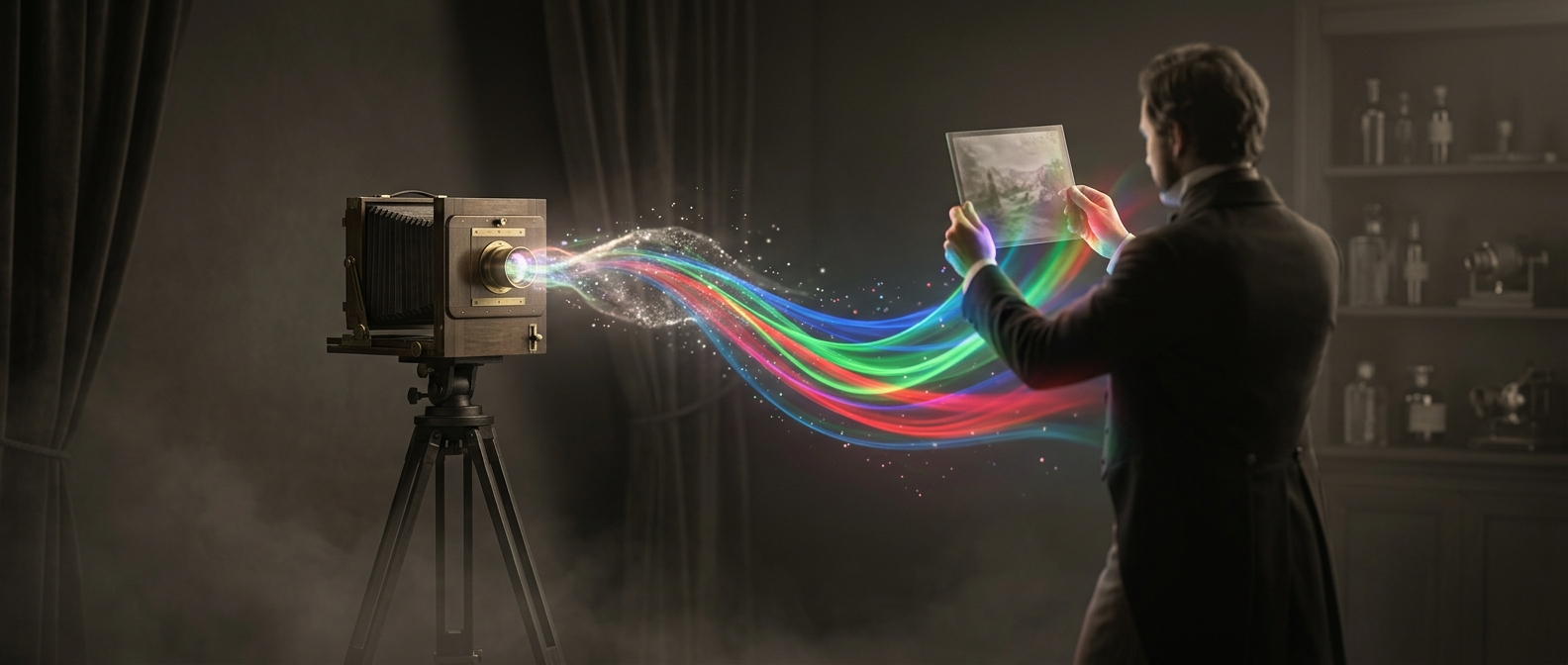
Each exposure was made through a filter that favored red, green, or blue light. The filters separated the ribbon’s colored pattern into three brightness maps. A red part of the ribbon, for example, would contribute differently to the maps made through the three filters than a blue or green part would.
Recombining the light
The images were then brought back together as colored light. Shine the red-filter image in red, the green-filter image in green, and the blue-filter image in blue, and align them precisely. Where all three beams overlap, the eye blends them into a single color. Where their brightnesses differ, the perceived color changes.
This is additive color mixing: colored lights combine in the eye, unlike paints or inks, which mix by absorbing light. The same basic red-green-blue principle later became useful in color displays, where tiny sets of colored lights make a full image appear continuous from a normal viewing distance.
Color as a set of instructions
The important step was not making three ordinary pictures look alike. It was treating each black-and-white exposure as a record of how strongly one part of the scene should contribute to one color channel. Together, the three maps carried enough information to reproduce the ribbon’s pattern in color.
That made the experiment more than a colorful picture. It showed that color could be captured and reconstructed from separate measurements—a way of turning a visual experience into parts that technology could store, transmit, and combine.