A frog’s poison begins with its next meal
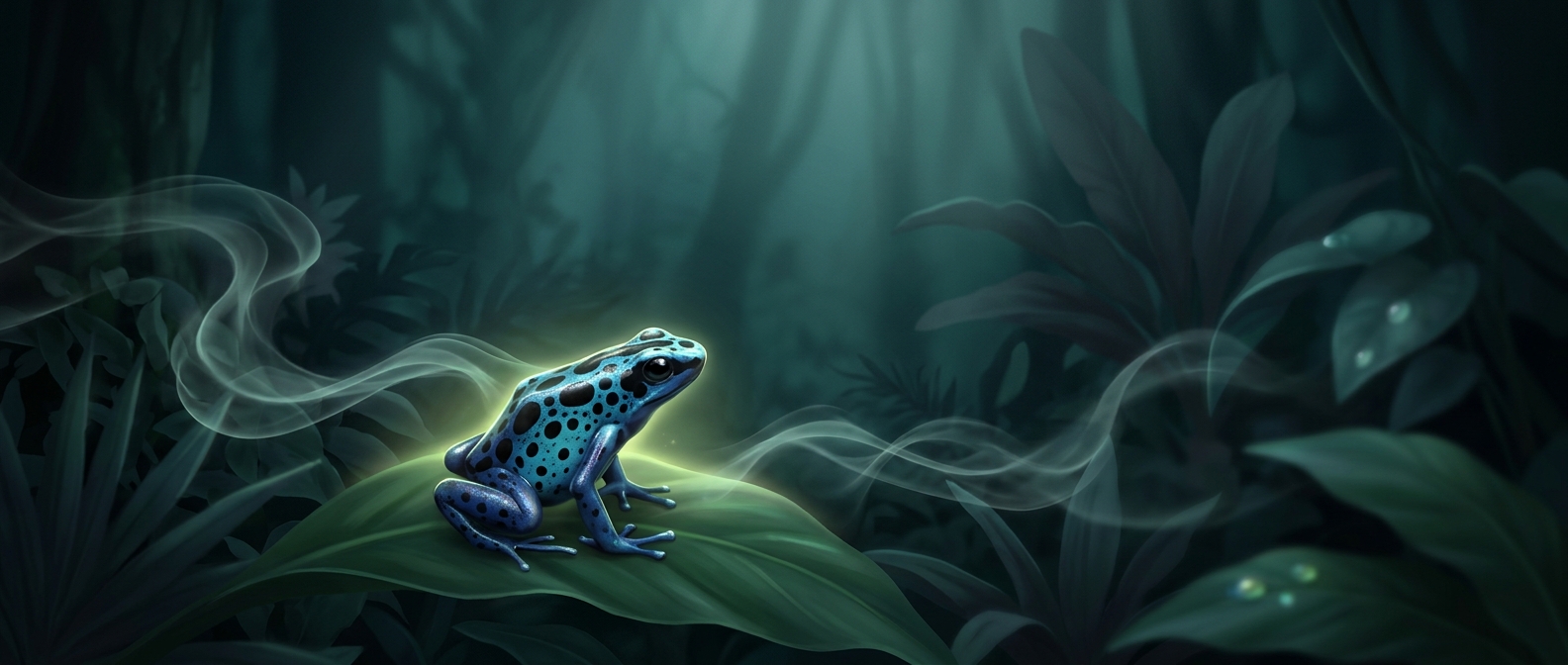
Many poison dart frogs do not manufacture their defensive alkaloids from scratch. In the wild, they acquire these nitrogen-containing chemicals by eating small invertebrates, including ants and mites. The frog’s skin then holds the compounds, turning tiny prey into a chemical defense for the animal that eats them.
That link to diet helps explain why the same kinds of frogs can differ sharply in toxicity. A frog raised in captivity on food that lacks the relevant chemicals may lose much of its natural toxicity. The poison is not simply a fixed feature switched on by the frog’s genes; what it can carry depends in part on what it has been eating.
What happens to an animal that eats one
Alkaloids are a broad family of compounds, and different frogs carry different mixtures. Some interfere with the normal work of nerves: they disrupt the signals that tell muscles when to contract. In a sufficiently large exposure, those signals can fail, leading to weakness, paralysis, or worse. The outcome depends on the frog, the toxin, the predator, and the amount absorbed—not every encounter has the same effect.
The bright warning colors make more sense alongside this hidden chemical supply. A predator that learns that a vividly colored frog causes a severe reaction may avoid similar-looking frogs later. The frog’s defense therefore has two parts: the toxins make an attack costly, while the colors can help prevent the attack in the first place. A meal of tiny insects can ultimately determine how dangerous that warning is.