How the moai crossed Rapa Nui
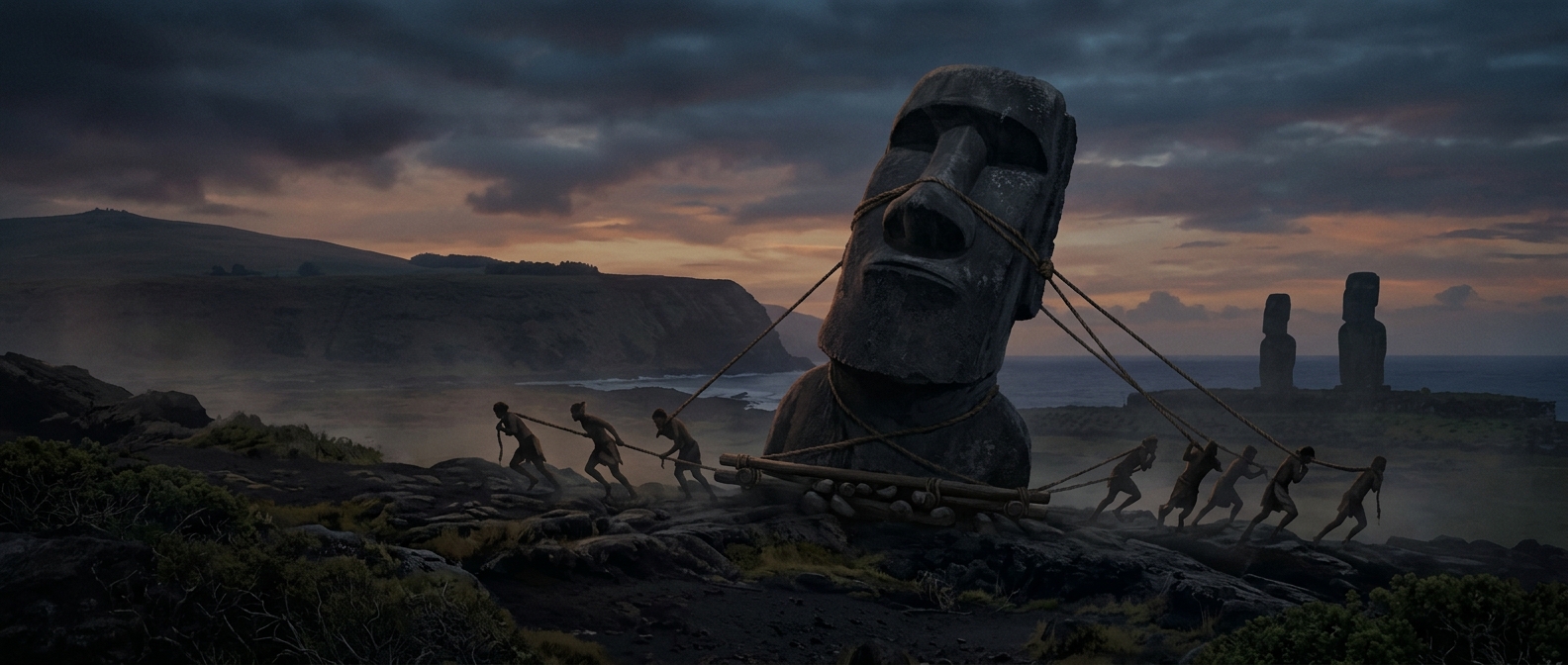
The giant stone figures of Rapa Nui, often called Easter Island, were carved mainly from soft volcanic rock at the quarry of Rano Raraku. Many still stand unfinished there; others were carried to platforms called ahu, often near the coast. Moving them meant guiding heavy, fragile statues over uneven ground without modern machinery.
One explanation, supported by experiments and the statues’ shapes, is that crews moved some upright. Ropes attached to either side could pull the figure alternately left and right, making it rock forward in small steps—rather like walking. Other proposals involve sledges or logs. The precise method may have varied, and no single account explains every statue.
A community effort, not just a feat of strength
Even if a statue could be made to “walk,” it would take coordinated teams to keep it upright and steer it. Roads, preparation, and repeated adjustments mattered as much as raw pulling power. The scale of the work suggests organized cooperation: people had to quarry, shape, move, and raise the figures, often in separate stages.
The coastal platforms also placed statues within the lived landscape of the island. Many ahu are associated with communities and ancestral remembrance, though the reason any particular statue was set in a particular place is not always clear. The journey therefore ended not simply at the shore, but at a built platform that connected a carved figure to a community—and left its builders’ engineering choices visible in the landscape.