Why the Moon raises two ocean bulges
The Moon’s gravity pulls on every part of Earth, but not equally. The side facing the Moon is slightly closer, so it feels a slightly stronger pull than Earth’s center. On the far side, the pull is slightly weaker. This difference across the planet—not the Moon’s total gravitational force—is what matters for tides.
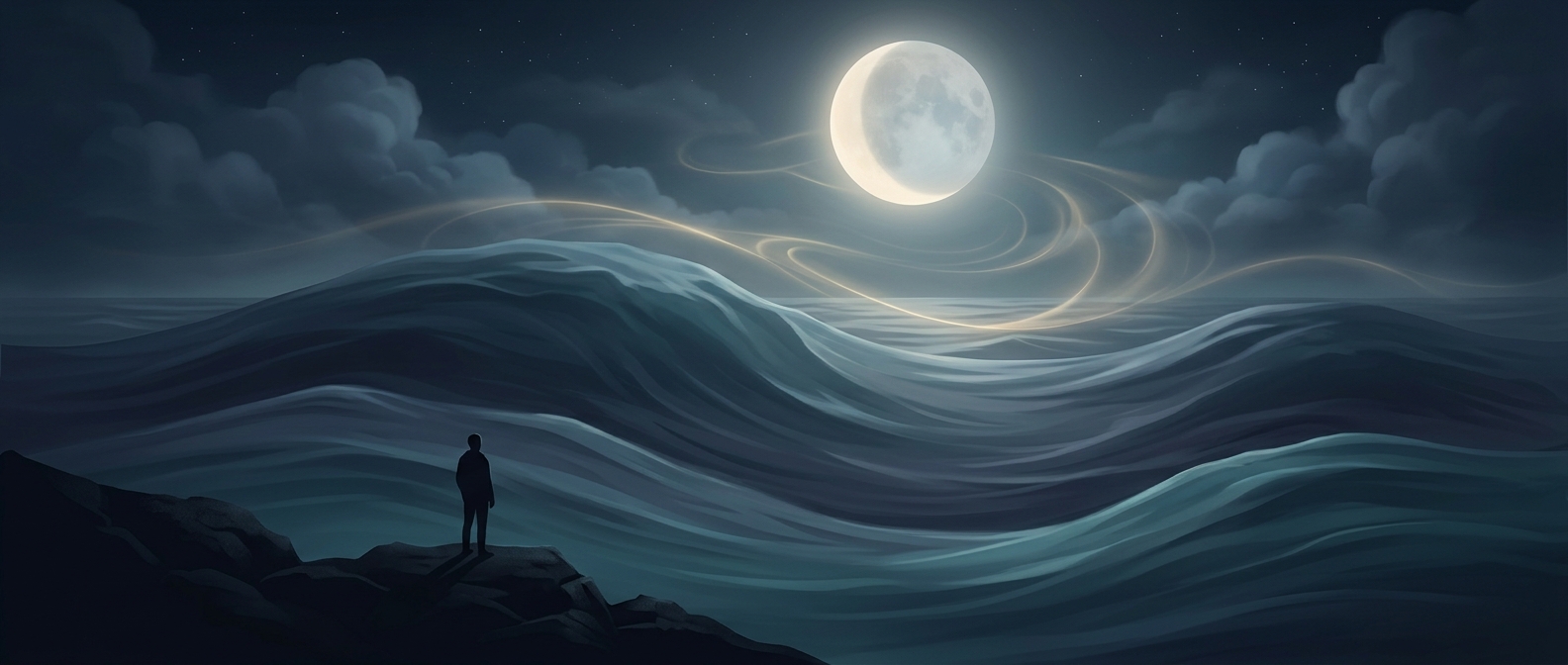
The result is a subtle stretching of the Earth-ocean system along the Earth–Moon line. Water gathers into a bulge on the near side, while the far side also bulges as Earth is pulled more strongly than the water there. These are not two separate waves racing across the globe. They are broad changes in the shape of the ocean, influenced by the continents and the ocean floor.
How a bulge becomes a high tide
Earth rotates beneath this stretched ocean. As a coastline moves into one of the broad bulges, sea level rises; as it moves away, sea level falls. Many places therefore experience two high tides and two low tides in roughly a lunar day, which is about 24 hours and 50 minutes. The extra time comes from the Moon moving along its orbit while Earth turns, so a location must rotate a little farther to line up with it again.
The Sun contributes its own tidal pull. When the Sun, Moon, and Earth line up, their effects reinforce one another and the tidal range—the difference between high and low water—tends to grow. When the Sun and Moon pull at right angles, their effects partly offset and the range tends to shrink.
Why local tides differ
The global pattern does not dictate an identical tide everywhere. Continents block and redirect water, while bays, coastlines, and seabed depth shape how tides rise and fall in particular places. The Moon sets the broad rhythm; local geography determines how that rhythm appears on a shore.