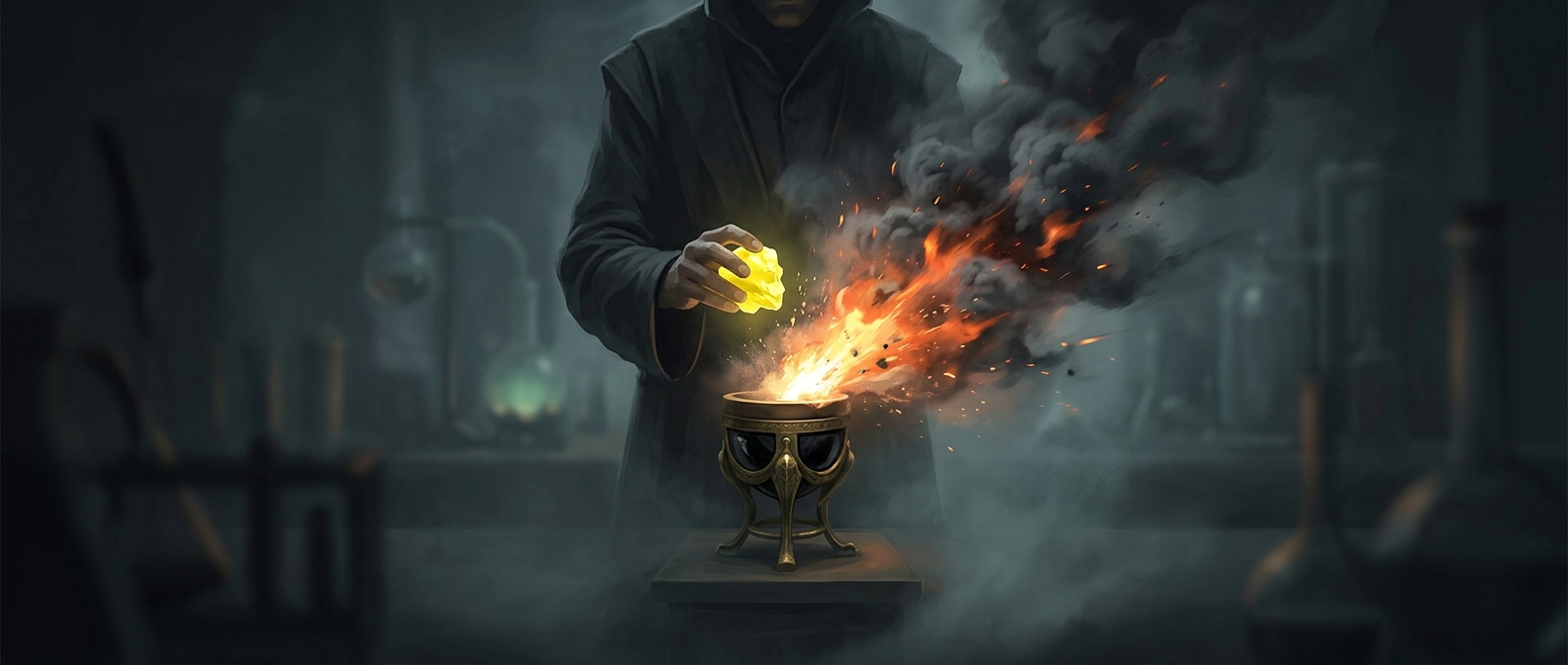
Why sulfur helps black powder catch
Black powder combines charcoal and sulfur as fuels with potassium nitrate, an oxidizer—a substance that supplies oxygen for burning. Sulfur’s role is not simply to add more fuel. It helps the mixture move from a small initial flame to sustained combustion.
Sulfur ignites more easily than charcoal. As it heats, it can also melt and spread among neighboring particles, helping heat pass through the tightly mixed ingredients. The burning sulfur releases enough heat to ignite charcoal and drive reactions involving the potassium nitrate, which supports further burning even where outside air cannot reach the mixture well.
A chain reaction, not an explosion of every grain at once
Once one part catches, heat and hot gases ignite nearby parts in sequence. That rapid spread is called deflagration: the reaction travels through the material by heat transfer, rather than by a supersonic shock wave as in a detonation. Sulfur helps make the first links in that chain easier to form; the other ingredients sustain it.
The practical consequence is that black powder can burn rapidly through its mixture instead of requiring every particle to be lit directly by the original flame. In a confined space, the hot gases have little room to expand, so pressure can rise sharply.