A Moving World Around a Still Body
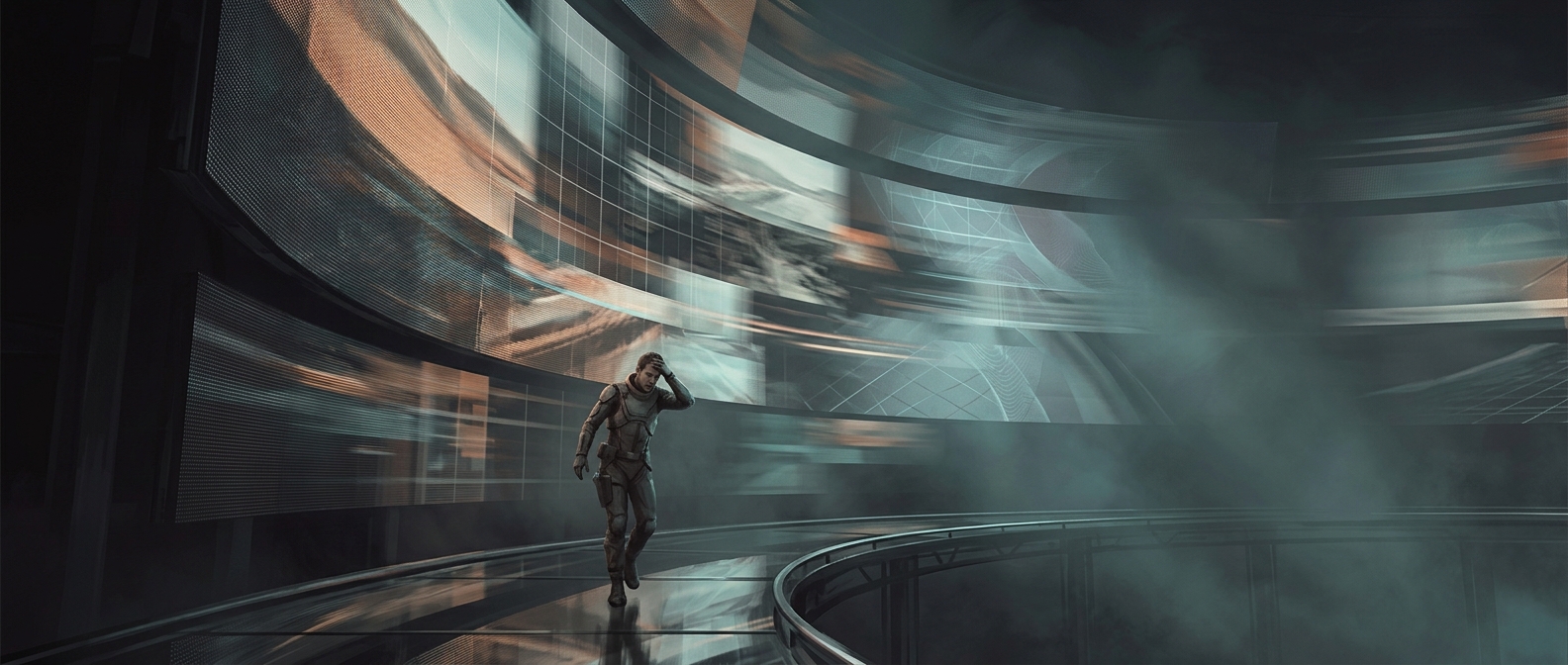
The Volume is a stage surrounded by large LED screens that display a computer-generated environment. Unlike a green screen, those walls show the scene while it is being filmed, so actors can see a landscape or spacecraft around them rather than imagining it against a blank backdrop.
The images also respond to the camera. As the camera moves, the virtual view shifts to preserve the sense of perspective—the way nearby objects appear to move more than distant ones. That makes the digital setting feel anchored to the camera’s position, but it means the picture on the walls can move even when the performers are standing still.
When Sight and Balance Disagree
The inner ear helps the brain track motion and balance. If an actor’s eyes register a sweeping virtual turn while the body and inner ear register no corresponding movement, the signals do not line up. That conflict can produce dizziness or nausea, much as a moving image can feel unsettling when the viewer’s body is stationary.
A related adjustment can happen when a virtual scene is repositioned to set up a shot. The image may rotate or shift across the surrounding screens as the crew resets the view. For an actor who remains in place, the room can appear to move without any physical cue that explains it.
The Tradeoff of an In-Camera World
Seeing the setting during a take helps performers react to the environment, and the screens provide light and reflections that belong to the scene. But that immediacy has a physical cost: the background is not simply a fixed picture behind the action. It is a responsive display whose movement can reach the actors’ senses even when the stage itself is still. A virtual camera adjustment can therefore affect not just how a shot looks, but how it feels to stand inside it.