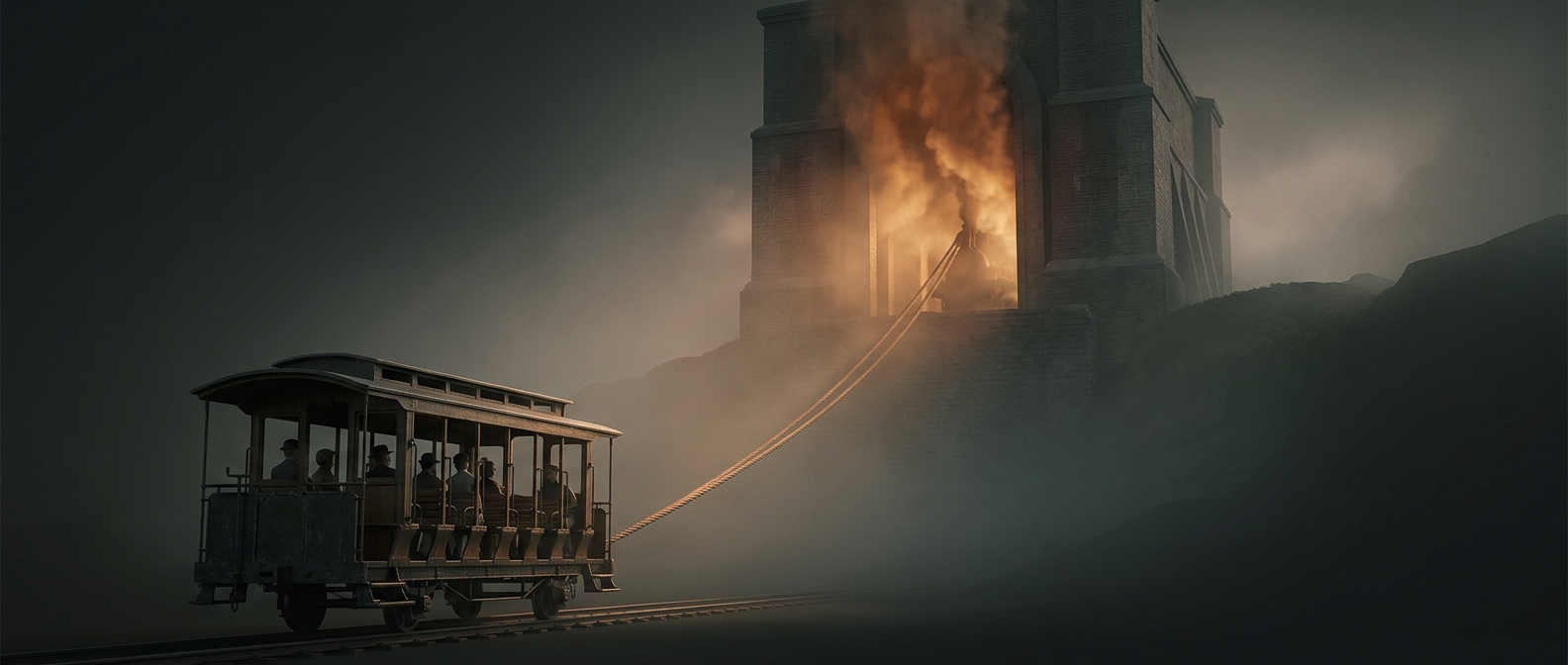
When the locomotive could not climb
Early railways did not always rely on a locomotive moving along the track. On steep inclines, a stationary steam engine could haul carriages with a cable instead. This was useful where a hill was too sharp for a locomotive’s wheels to grip the rails reliably, but a route still needed to carry coal, stone, or passengers up and down.
A winding engine did the work
The engine turned a large drum, winding in a rope or cable attached to the carriage. Pulleys guided the cable along the track, so the engine could remain at a fixed point while the carriage traveled. Brakes and careful control mattered: the cable was not just a towline, but the connection that governed movement on a slope.
Some systems used two carriages linked by the same cable. As one descended, its weight helped pull the other uphill, reducing the effort required from the engine. That arrangement made the hill itself part of the machinery.
A railway built around its terrain
Cable haulage was a practical answer to a specific engineering problem, not simply an early version of the modern locomotive. It allowed railways to cross steep ground before engines powerful enough for such gradients were practical. Later, more capable locomotives could handle many routes directly, while cable systems remained useful on sharply inclined lines.
The striking detail is that “the train” did not have to contain its own motor: on an incline, the power plant could stand still while a cable carried its force to the moving carriages.