A railroad joined at Promontory Summit
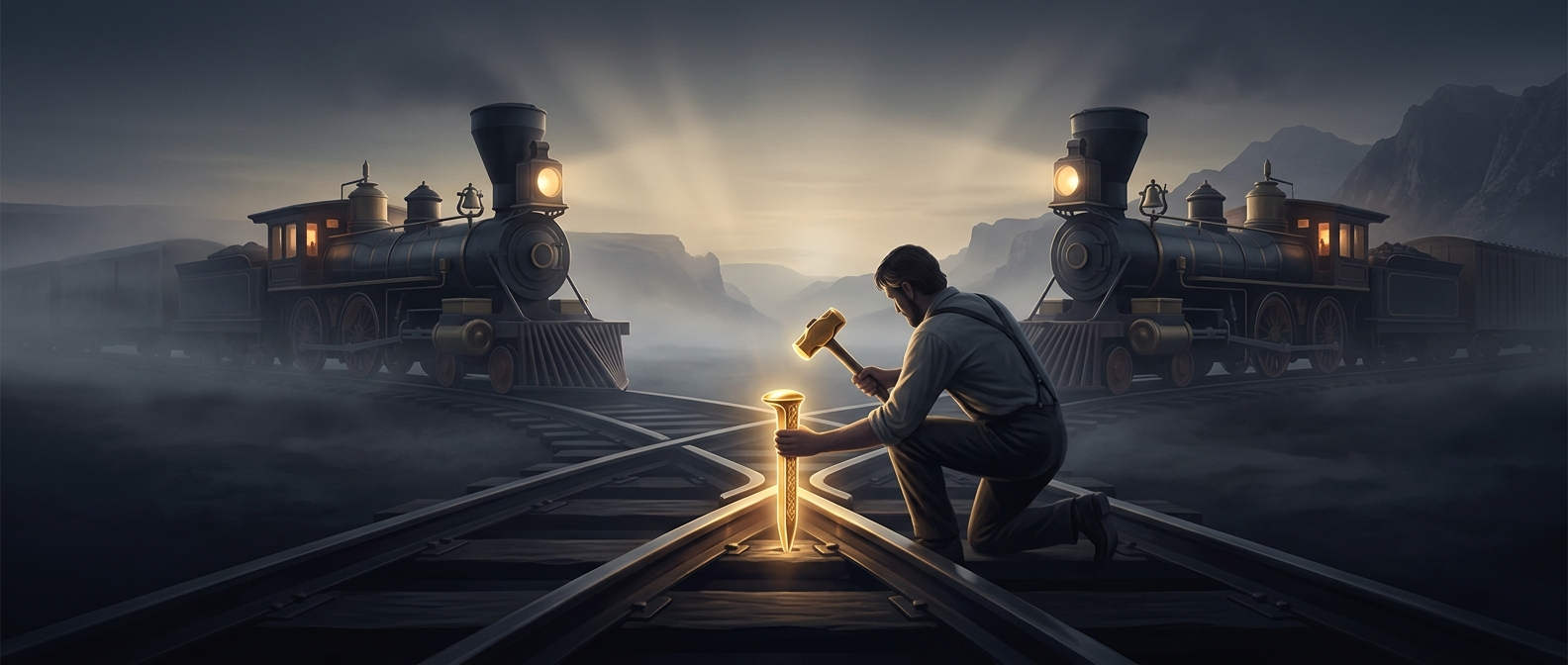
On May 10, 1869, workers from the Union Pacific and Central Pacific railroads met at Promontory Summit in Utah Territory. The Union Pacific had built westward from the Missouri River; the Central Pacific had pushed east from California, crossing the Sierra Nevada. Their tracks finally connected, creating a rail route across the continent.
The celebrated golden spike was a ceremonial marker of that connection, not simply an ordinary piece of track hardware. The ceremony gave the immense, difficult construction project a vivid finish: two building crews—and two railroads advancing from opposite directions—had reached the same point.
What the connection changed
Before the link, traveling between the eastern United States and California meant a long overland journey, a sea voyage, or some combination of the two. The rail connection made a much faster journey possible. Passengers still had to manage the practicalities of a changing rail network, but the continent no longer stood between them and a continuous route by train.
For businesses, the change was just as consequential. Goods could move between the coasts overland more quickly, helping tie distant markets together. The railroad also encouraged settlement and commerce along its route, while its expansion disrupted Indigenous peoples whose lands and ways of life were affected by the advancing tracks.
The spike’s lasting significance is therefore larger than the ceremony: it marked the moment when two separate construction efforts became a transportation link across the United States.