A pyramid could make a four-way randomizer
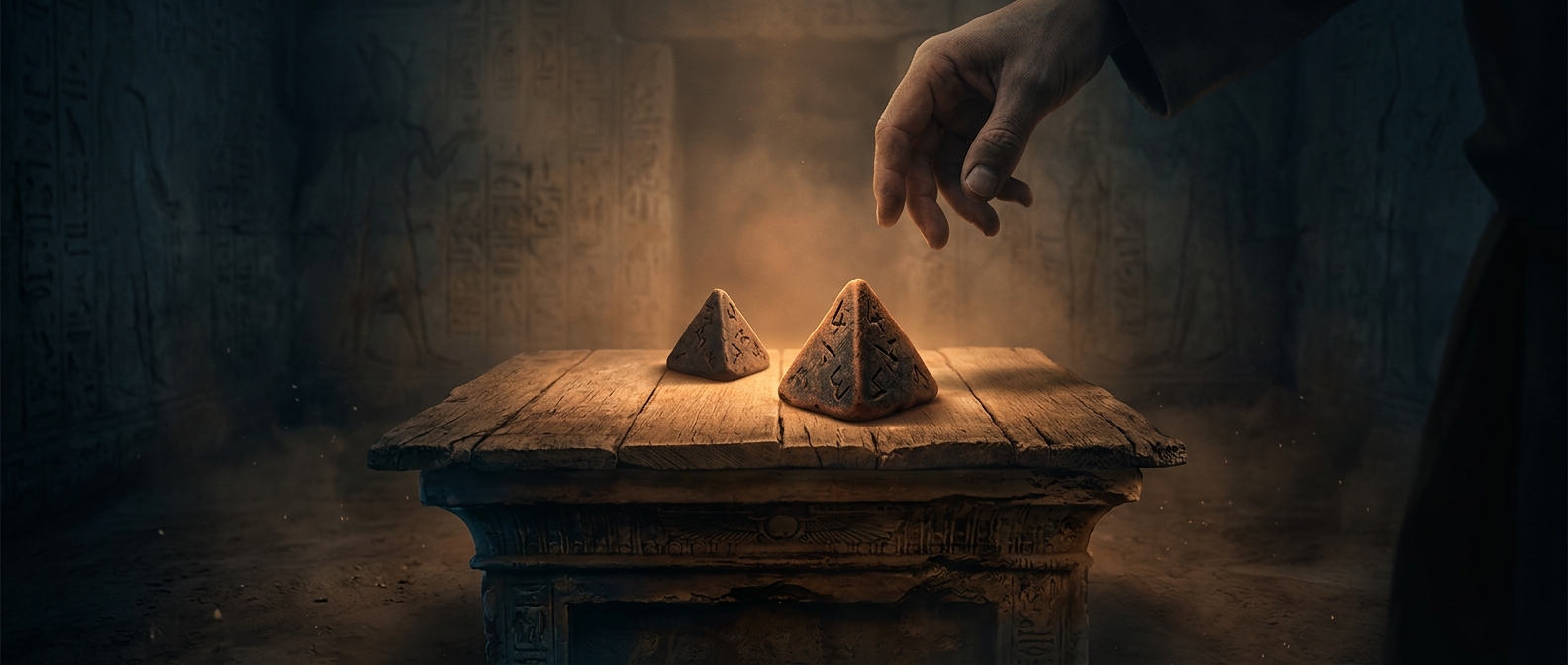
A solid four-sided pyramid—more precisely, a tetrahedron—has four triangular faces. When tossed, it can settle in any of four orientations, giving a race-game player a small set of possible results. That was enough to turn a move into a chance: instead of choosing how far to advance, a player let the throw decide among the options allowed by the game.
The object’s shape also shows that a die did not have to be a cube. A pyramid tumbles differently from a familiar six-sided die, but its sloping faces still let it shift before coming to rest. The game needed a repeatable way to read the result, not a particular geometry.
The game made the object meaningful
A die has no useful outcome on its own. Players need a convention that connects each resting position to a move. The surviving account identifies these pyramids as tools for a race game, but it does not establish the exact rules or how players read every result. What it does reveal is the basic design: a compact object could introduce chance into turn-taking and determine who moved when.
Found in ancient royal tombs, these early examples also show that games were important enough to accompany the dead. Their four-sided form is a reminder that the familiar cube was only one solution to a simple problem: how to let a throw settle a game’s next move.