Why a triangle resists changing shape
A frame made from rigid bars and loose joints can still move. Four bars joined into a square can pivot until the square becomes a slanted parallelogram, without any bar getting longer or shorter. The joints allow motion, so the frame has a degree of freedom: a way to change shape while keeping its parts intact.
Three bars joined into a triangle have no equivalent motion. Once the three side lengths are fixed, the angles are fixed too. To make the triangle wider or flatter, at least one side must change length—or a joint or bar must bend. That is the geometric source of its rigidity.
How a diagonal brace locks a frame
In a square frame, a diagonal divides the open space into two triangles. If the corners are connected by rigid joints, the diagonal fixes the distance between opposite corners. The frame can no longer shear into a diamond without changing the length of a bar. The brace has turned an easily distorted shape into two constrained ones.
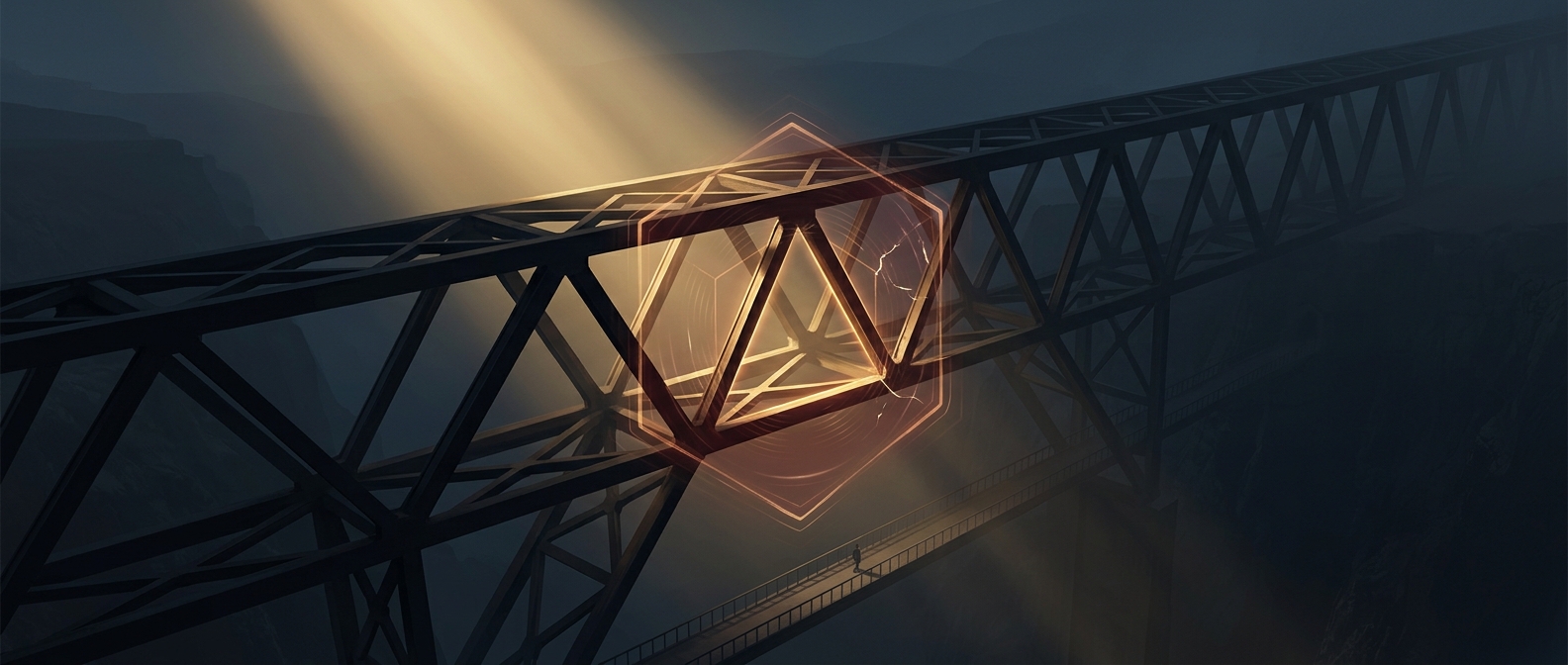
This is why triangular bracing appears in roof trusses, bridges, towers, and other structures built from slender members. A truss carries loads through bars that are mainly pulled or pushed along their lengths, rather than relying on every joint to resist bending. That can make a structure both stiff and economical in material.
Geometry is not the whole structure
A triangle is rigid only under the right assumptions: its sides must resist stretching or buckling, and its joints must hold the bars in place. Real materials deform, and a long, thin bar under compression can buckle. Engineers therefore choose member sizes, connections, and bracing to handle the actual loads.
The useful lesson is not that triangles cannot fail, but that their geometry removes a simple route for a frame to wobble. One diagonal can stop a whole rectangular bay from racking, while the bars themselves remain straight.