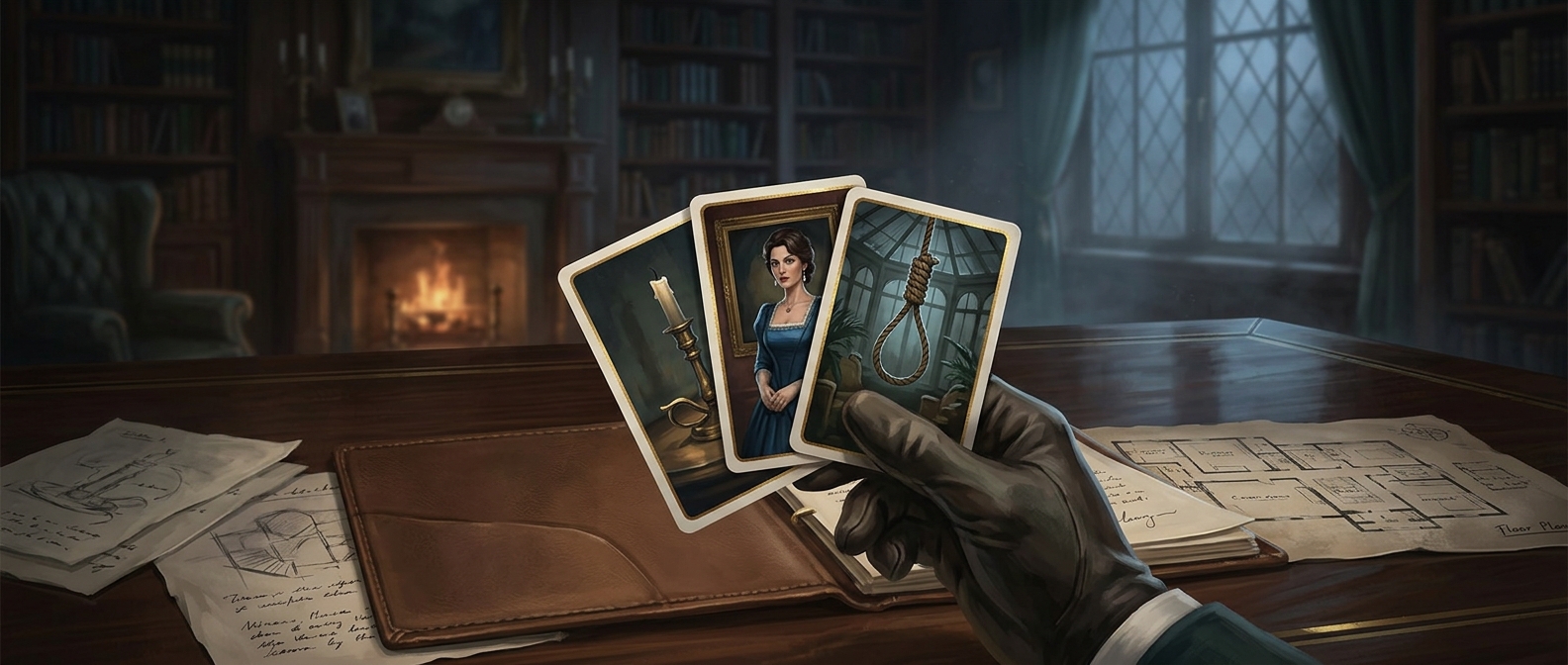
A murder mystery built for deduction
The lasting idea behind Clue was not simply to let players act out a murder mystery. It was to make solving one a process of elimination. A hidden set of cards identifies the culprit, weapon, and room; the rest are dealt among the players. By making suggestions and watching how others respond, players can work out which possibilities cannot be in the hidden set.
That turns a parlor-game premise into a compact logic puzzle. A suggestion—such as a particular suspect with a particular weapon in a particular room—tests several possibilities at once. A player who can disprove it must show a matching card privately, giving the person who made the suggestion useful evidence while leaving everyone else uncertain about exactly what was shown.
Why the table matters
The game’s social mechanics are part of the puzzle. Players gather information not only from their own cards but from who can answer a suggestion, and sometimes from who cannot. Keeping notes helps turn those scattered clues into a narrowing list. The challenge is to distinguish what a player knows from what the group can see: a correct deduction may depend on evidence that only one person received.
The board gives those deductions a setting and a sequence. Moving between rooms creates opportunities to make suggestions, while the limited set of suspects and weapons keeps the mystery manageable enough to solve in a sitting. The result is a balance between chance—movement can affect access to rooms—and reasoning, which determines whether a player can identify the concealed combination.
From parlor entertainment to a boxed game
Pratt’s design drew on murder-mystery games played in homes, but a commercial board game needed rules that could be repeated by people who had never met him. The hidden cards and private answers supplied that structure: each play began with a different mystery, and the players could investigate it without a host scripting the evening.
The original patent name, Murder, stated the premise bluntly. The familiar title Cluedo emerged for the British game, while the American version became Clue. Beneath either name is the same satisfying turn: a room, a suspect, or a weapon disappears from consideration because one small piece of evidence makes it impossible.