The collision left matter in two different places
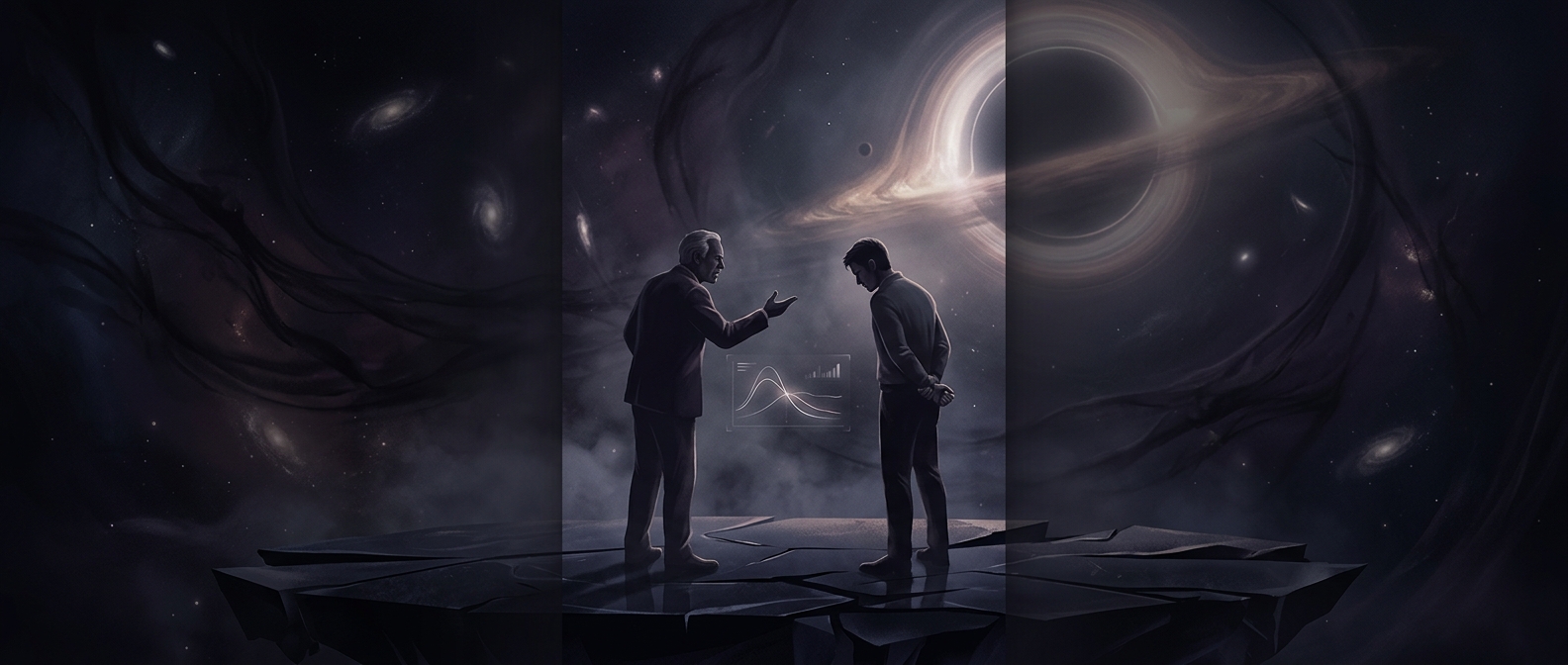
When two galaxy clusters pass through one another, their contents do not all behave alike. The galaxies are separated by enormous distances, so most pass without colliding directly. The clusters’ hot gas, by contrast, is spread through space and interacts strongly: gas from the two systems rams together, slows, and heats up.
That difference creates a cosmic separation. In the Bullet Cluster, the hot gas is concentrated near the collision zone, while most of the cluster’s gravitating mass lies in separate regions that moved farther ahead.
Gravity reveals what telescopes cannot see
Astronomers locate that unseen mass through gravitational lensing. Mass bends spacetime, changing the paths of light from more distant galaxies; by measuring the resulting distortions, researchers can infer where the mass is concentrated. Lensing does not photograph dark matter itself—it maps the gravity of everything along the line of sight.
The reconstructed mass peaks in the Bullet Cluster align much more closely with the galaxies than with the centrally slowed gas. Since the galaxies contain only a small share of the ordinary matter, this mismatch points to a substantial, largely invisible component accompanying them through the encounter.
A strong test of dark matter’s behavior
The pattern is expected if dark matter interacts little with itself and with ordinary matter: unlike the gas, it would not be held up by a collision between the clusters. The observation therefore provides striking evidence that most of the mass is in a component that behaves differently from the hot gas.
It does not show dark matter as ghostly particles passing through one another, nor does one collision establish that dark matter has absolutely no interactions. What makes the cluster so compelling is the spatial clue: the gas piled up, while the main mass concentrations continued onward.