A detector measured the air’s electrical leak
Hess’s instrument was an electroscope: a device that detects electric charge by how quickly its charged parts lose charge. Radiation can knock electrons loose from atoms in the air, making the air more conductive and speeding that loss. The instrument therefore offered a way to track radiation even when its source was invisible.
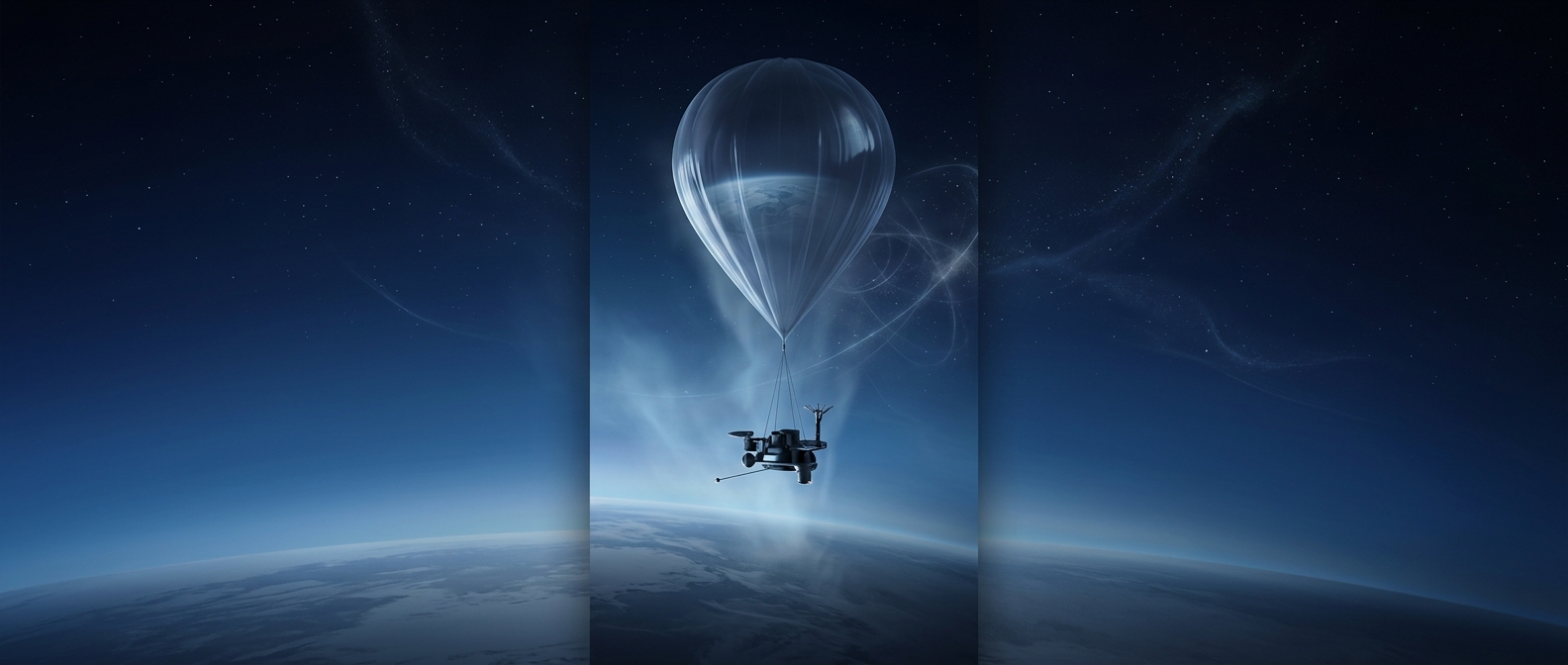
Near the ground, radioactivity in rocks and soil was a known source. If that were the whole story, climbing through more of the atmosphere should have reduced the reading: the detector would be farther from much of the ground’s radiation. Hess’s measurements instead rose markedly at high altitude. The pattern made a source above the atmosphere the stronger explanation.
Space supplies the particles; air reshapes them
Cosmic rays are mostly fast-moving protons and atomic nuclei arriving from space. When one strikes a molecule high in the atmosphere, the collision can produce a cascade of new particles. Those particles may collide again, creating a particle shower that spreads downward through the air.
That distinction matters: a detector on the ground usually does not register the original space particle. It detects some of the shower’s descendants. The atmosphere is both a shield, absorbing or slowing much of the incoming energy, and a target that generates the secondary particles reaching lower altitudes.
Why the climb changed the picture
At higher elevations, there is less air above a detector to absorb the shower. More of its particles can reach the instrument, so the measured radiation can increase even though the atmosphere blocks much of the radiation arriving from space. Hess’s balloon results helped establish that the source was not confined to Earth, opening the way to studying energetic particles through the traces they leave in the atmosphere.
The counterintuitive legacy is that the air between space and the ground does not merely hide cosmic rays: it turns their collisions into a rain of detectable particles.