The train’s speed stays with the jumper
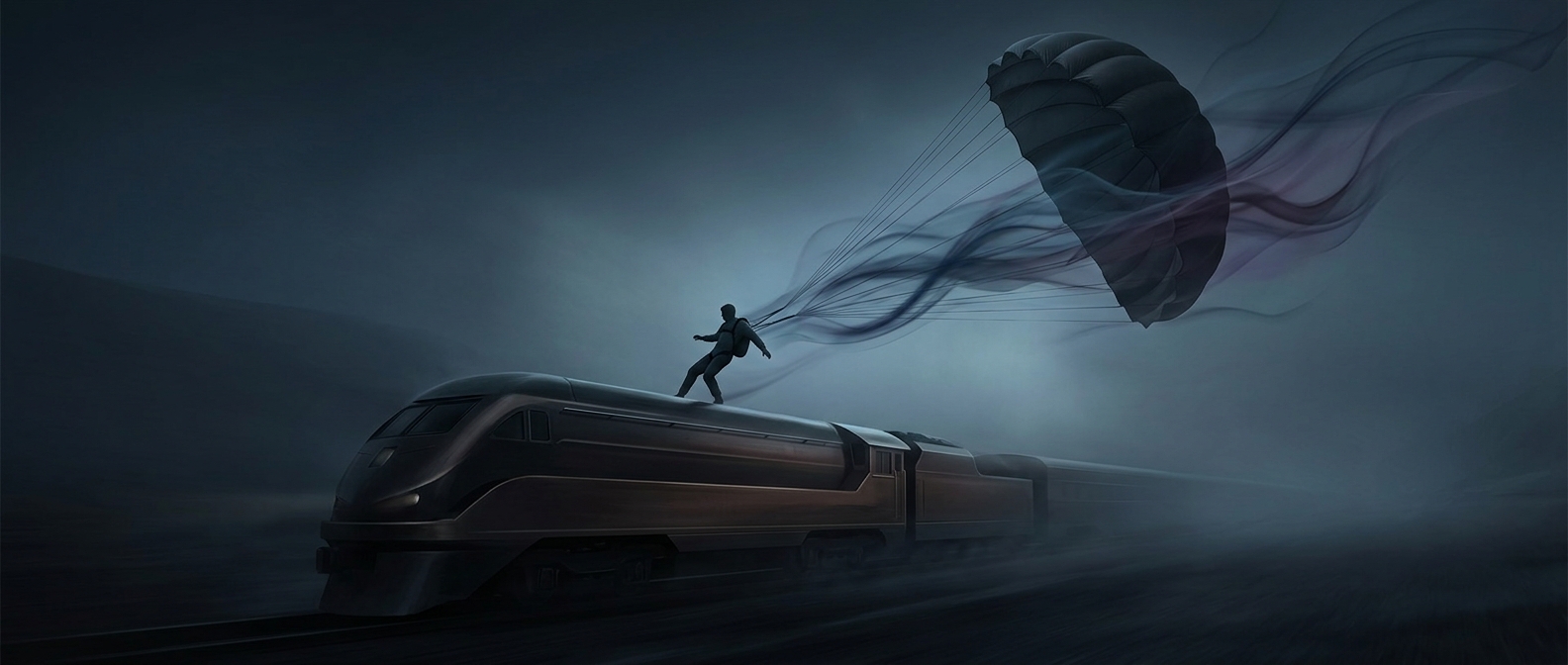
Stepping off a moving train does not make a person stop moving forward. At the instant of the jump, the jumper still has nearly the train’s forward speed. From the ground, that means the person travels down the track as well as downward; from the train, the same motion can look like a drop straight away from the carriage.
The difference between those views is relative motion: movement described from one observer’s point of view. It is why a person can leap from a train without being flung backward simply because the train is moving.
The parachute changes the motion gradually
A parachute works by presenting a broad surface to the air. The resulting drag—the air’s resistance to motion—opposes the jumper’s descent and reduces the rate of falling. It does not erase forward speed in a single instant. Air resistance gradually changes the jumper’s motion, while gravity continues to pull downward.
That makes the timing and clearance of the jump crucial. The jumper must leave the train and open the canopy with enough space to avoid the carriage and tracks. The train is not just a dramatic backdrop: it is a moving launch point, carrying the jumper forward before the parachute begins to control the fall.
A launch pad that keeps moving
Unlike a stationary platform, a train gives the jumper forward momentum that must be accounted for throughout the leap. The spectacle comes from that two-part movement: a fall toward the ground combined with travel along the railway. The parachute manages the descent, but the train’s speed is already part of the stunt.