How the Chima Stays in Place
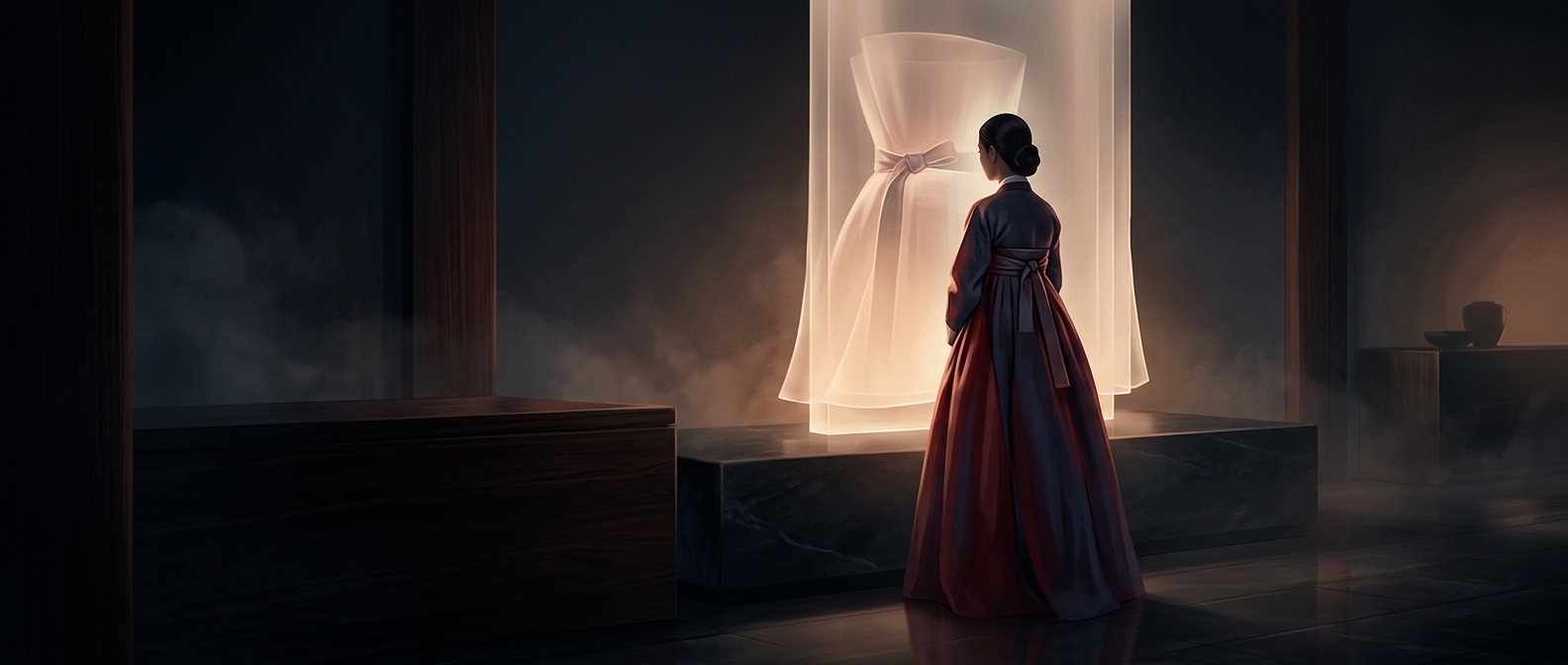
A traditional Korean women’s hanbok pairs a short jacket, the jeogori, with a full skirt called a chima. Rather than shaping the skirt around a narrow waist, the wearer wraps its upper band around the torso and secures it high on the chest. Long attached straps help hold the garment up; the jacket covers the tied area.
That construction makes the chima less like a modern skirt with a waistband and more like a broad length of fabric gathered into a wearable shape. Pleats or gathers at the top release into the skirt’s full width, while the upper band anchors the weight against the body. The fabric can therefore form a rounded outline without a closely fitted waist.
One Shape, Room for Variation
The silhouette depends on how the skirt is arranged, as well as on its fabric, fullness, and layers. A chima worn over undergarments can take on more volume, while a lighter or less layered outfit falls differently. The high fastening is a feature of the garment’s construction, not a rule that every hanbok looks identical: styles and proportions have varied across time and occasion.
Because the waist is not tailored into the skirt, the garment’s shape comes from how fabric is gathered and supported. That is the practical trick behind its sweeping outline: a secure point high on the body lets a wide skirt hang freely below.