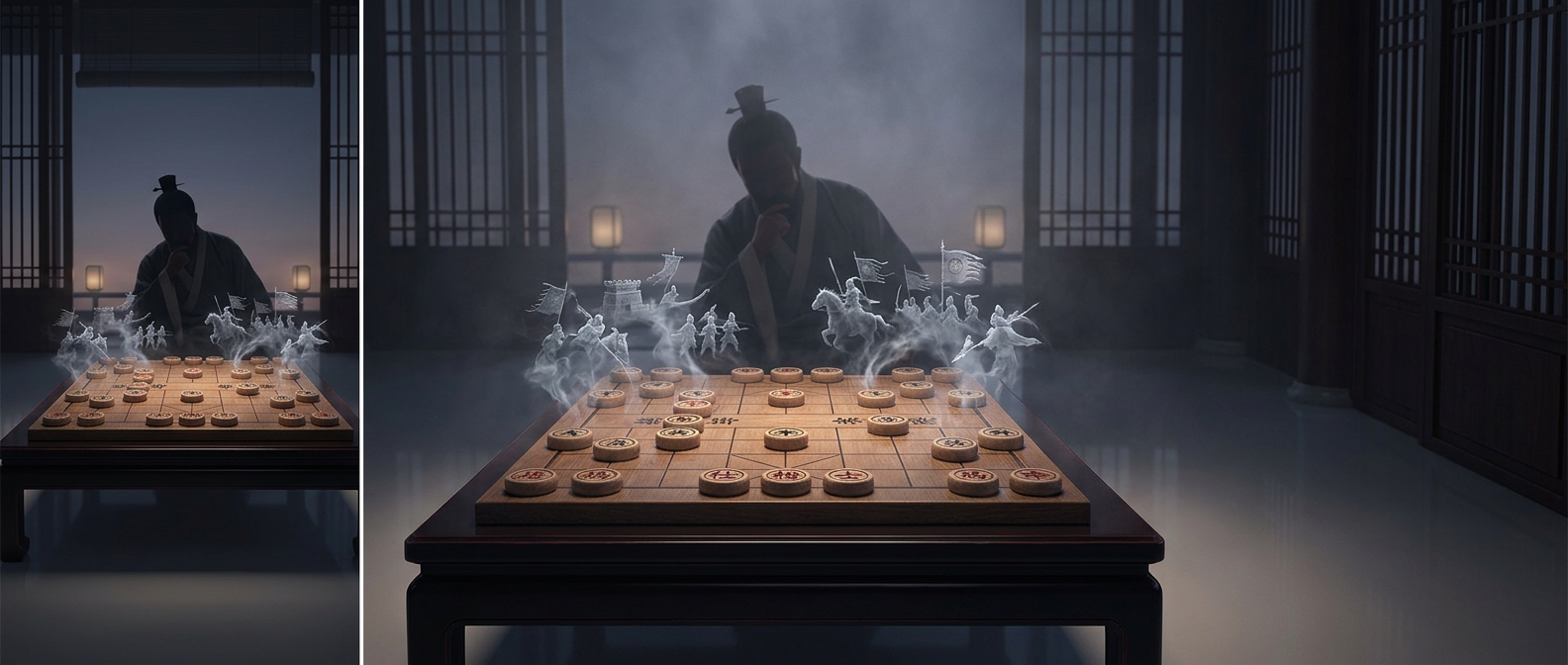
Xiangqi Makes Geography a Tactical Problem
In xiangqi, the Chinese game often called Chinese chess, pieces sit on the intersections of a grid rather than inside its squares. That small difference matters: a piece’s legal routes are defined by the lines it can travel, while the board’s marked regions limit where some pieces may go.
The River Changes the Pieces’ Jobs
The river divides the two halves of the board, but it does not affect every piece alike. Elephants must stay on their own side, so they cannot reinforce the opponent’s territory. Soldiers, by contrast, become more mobile after crossing: they can move sideways as well as forward. Reaching the far bank can therefore turn a slow advancing piece into a useful attacker or blocker.
The river is not a wall that seals the armies apart. Generals can face one another along an open file, and other pieces can cross or attack across the divide. Players must weigh the value of pushing forward against the danger of opening a line toward their own general.
The Palace Creates a Defensive Center
Each general is confined to a small palace at the heart of its side, and advisors are confined there too. This makes the general’s escape routes limited and gives defenders a compact area to protect. A rook can threaten along an open row or file; a cannon can capture only when exactly one piece lies between it and its target. A harmless-looking piece can thus become the screen that enables a sudden attack.
The result is a board where position is more than proximity. A soldier crossing the river, an elephant cut off from the fight, or a single piece placed between cannon and target can reshape the available threats. In xiangqi, the lines and boundaries of the board are active parts of the contest.