A vehicle that changes its support
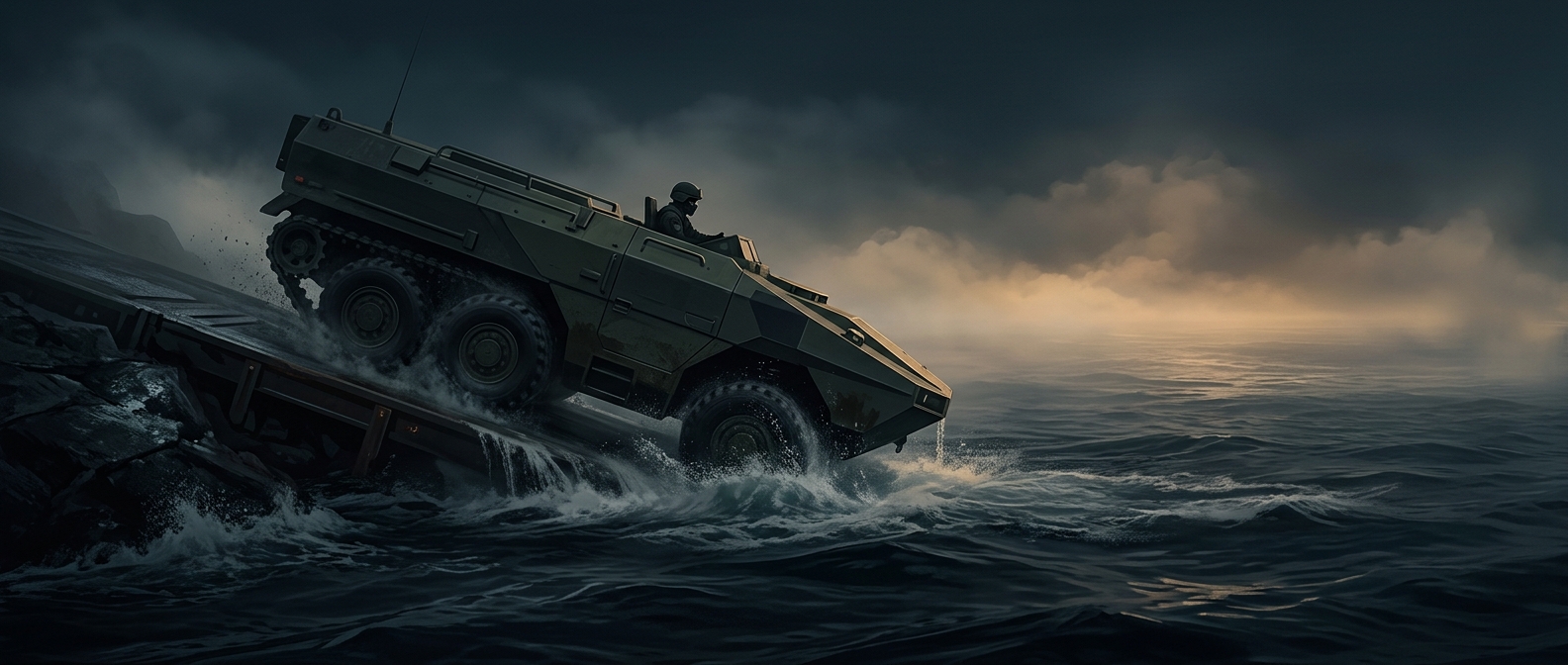
On land, the tires carry the vehicle’s weight. As it descends a bank into open water, the sealed hull displaces water—pushing it aside—and the resulting buoyant force supports the vehicle once it is afloat. The transition is gradual: the tires may still touch the bottom as the hull begins to take the load.
That sealed hull is the key to making the change possible. Openings and joints must be protected against water entering, while the vehicle’s weight and shape must allow it to float with enough of the hull above the surface. This is not simply a truck with a propeller attached; the body has to work as a boat as well as a land vehicle.
The shoreline is part of the route
At the water’s edge, the vehicle needs a bank it can descend and a bottom it can leave without getting stuck. Once afloat, tires alone are not an effective way to travel through open water, so a propeller supplies forward thrust. The vehicle’s design must make that land-to-water handoff possible without losing control or taking on water.
The compromise is practical: a body built to float and travel through water has to carry extra structure and equipment that an ordinary land vehicle does not need. In return, it can cross a shoreline without stopping to load onto a separate boat. The same machine carries its wheels to the edge, then lets the hull—and its own water propulsion—take over.