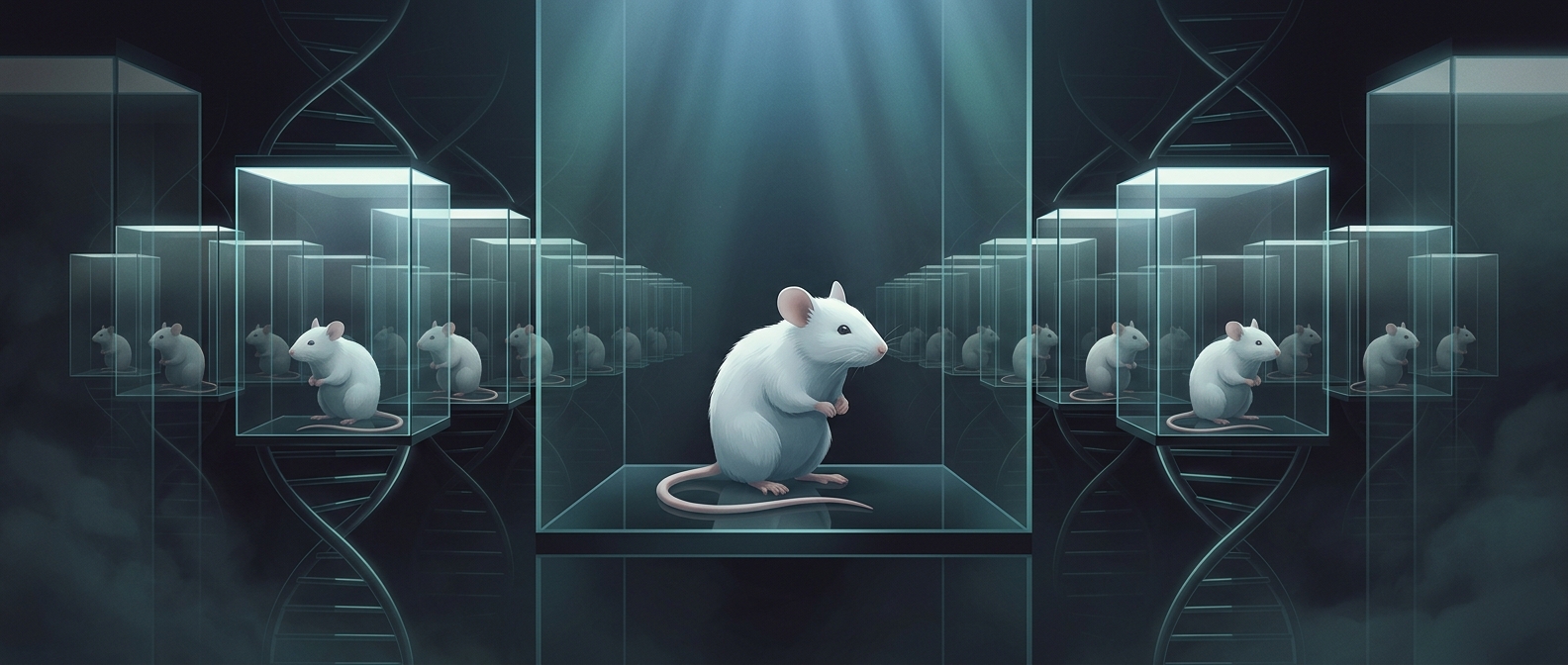
How a mouse strain becomes genetically uniform
Many laboratory mice come from inbred strains: generations of close breeding that make animals within a strain highly similar genetically. Researchers can therefore begin an experiment with fewer inherited differences in traits such as metabolism or immune response—factors that might otherwise affect how an animal reacts to a drug.
That uniformity makes the comparison easier to interpret. If treated mice differ from untreated mice raised under the same conditions, researchers have fewer genetic variations to account for when asking what caused the difference. It can also make results less noisy, so a treatment effect is easier to detect.
The control comes with a blind spot
A result in one strain describes how the treatment acted in that particular genetic background, not how it will act in every mouse—or in people. Genes can influence how a drug is absorbed, broken down, or recognized by the immune system. A treatment that appears effective in one strain may have a weaker effect, a different effect, or more side effects in a genetically different group.
The same uniformity that clarifies one experiment can therefore conceal variation that matters in the wider population. It is a tool for isolating cause, not proof that the result applies broadly.
From a clean test to a broader one
Researchers can use a uniform strain to investigate a focused question, then test whether the finding holds across other strains or in other models. That second step is harder to interpret because more biological factors vary, but it can reveal whether a promising result depends on a narrow genetic setting.
The practical consequence is that a successful mouse experiment is a starting point for judging a treatment, not a preview of how every patient will respond.