How a Flat Dish Made Microbes Easier to Study
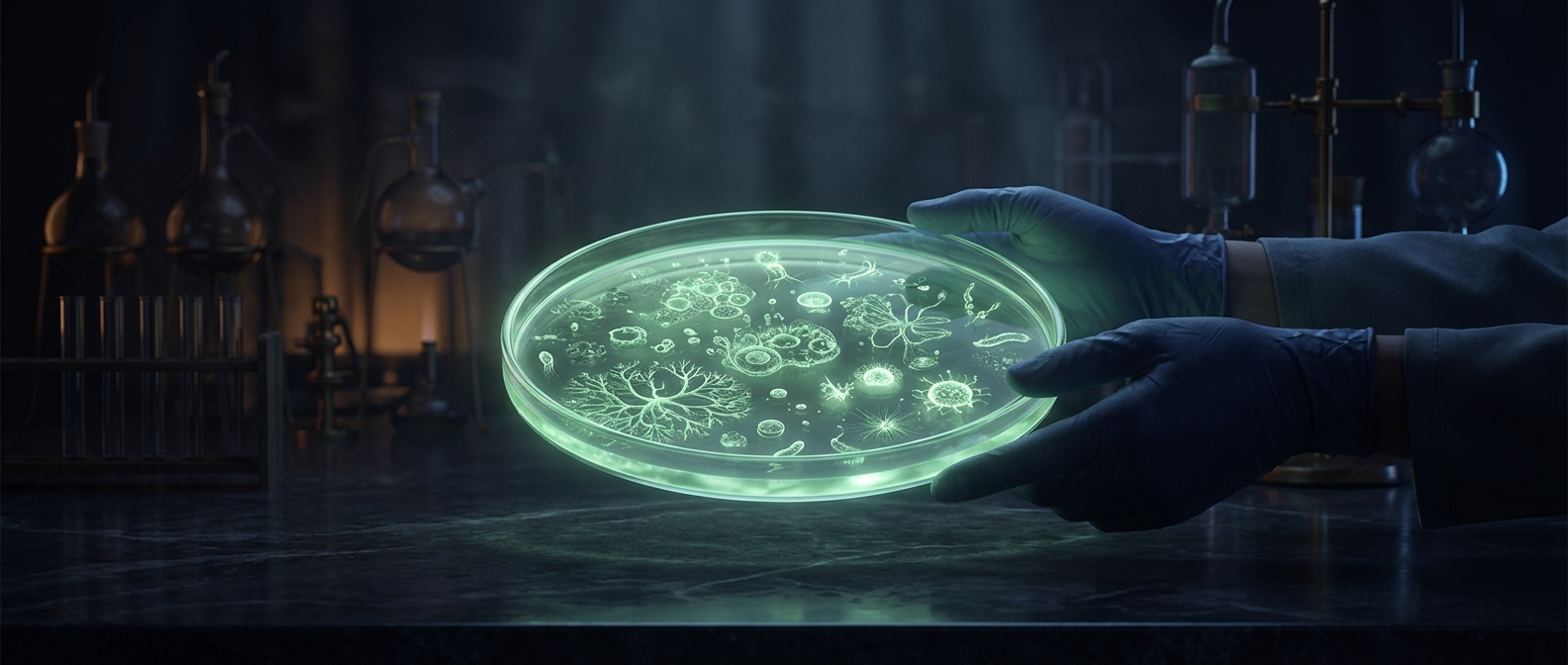
Before researchers could reliably examine microbes one kind at a time, they needed a way to keep them growing in place. A Petri dish holds a thin layer of nutrient-rich gel—often agar—so microbes can multiply across a surface instead of dispersing through liquid. The transparent, shallow container makes the growth easy to inspect.
When a sample is spread thinly over the gel, individual microbial cells can become separate colonies: visible clusters descended from cells that landed in different spots. A researcher can then select a colony and grow it separately. That turns a mixed sample into something much closer to a controlled experiment.
From Visible Dots to Comparisons
The dish’s value is not just that it keeps microbes contained. Its broad surface lets researchers see where growth appears and compare patterns across samples. They can test how organisms respond to different nutrients or conditions, or observe whether a substance prevents growth. The gel stays put while the organisms develop, making changes easier to track than in a stirred liquid culture.
The lid reduces contamination from organisms drifting down from the air, though it does not make the dish a sealed or perfectly sterile system. Its shallow shape also makes dishes easy to stack, so many experiments can occupy a small incubator at once.
A Small Design with a Lasting Role
The dish is named for German bacteriologist Julius Richard Petri, who developed it while working in Robert Koch’s laboratory in the 1880s. Its enduring contribution was practical: it gave researchers a repeatable way to grow, separate, and inspect microbes on a manageable surface. A dot on the gel could become the starting point for identifying an organism—or for testing what might stop it from growing.