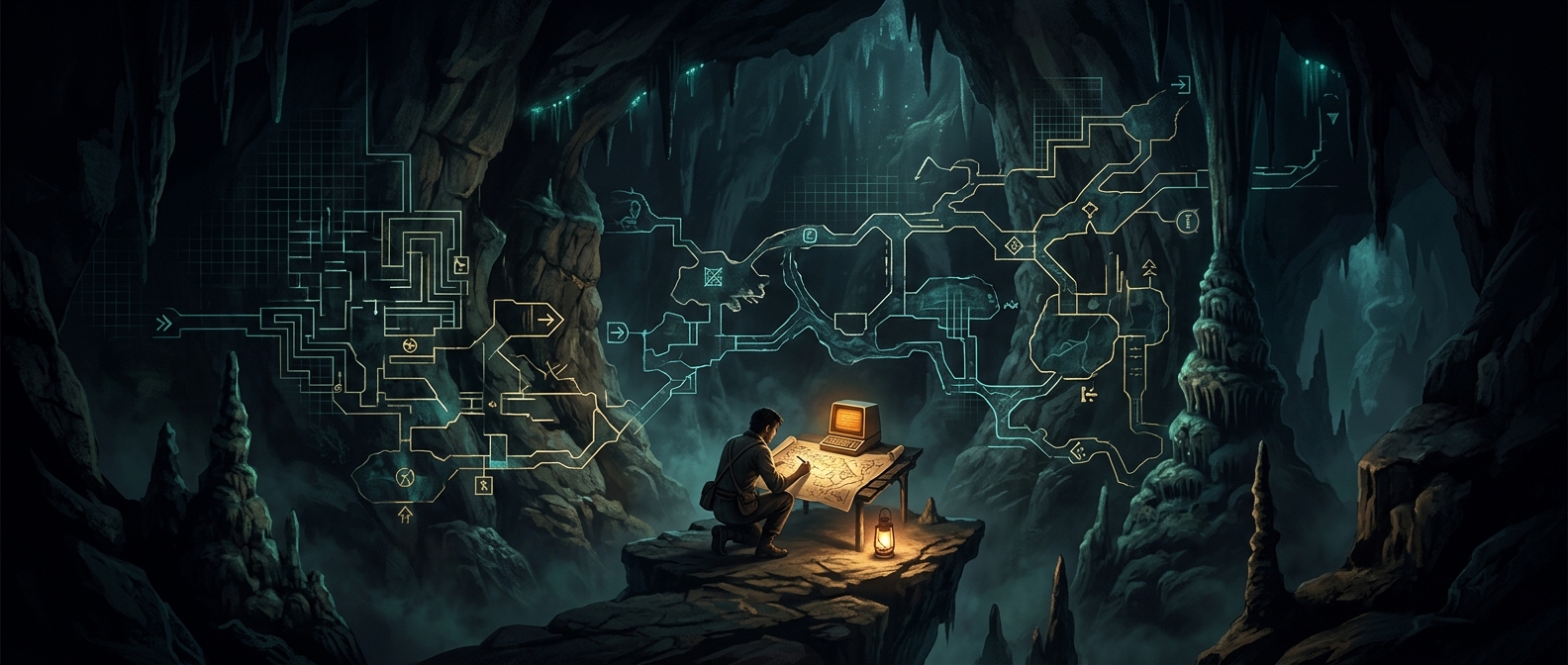
Turning a Cave Map Into a World of Words
The real cave behind Colossal Cave Adventure was not simply scenery copied into a game. Its creator, Will Crowther, was an experienced caver, and he drew on his knowledge of underground exploration to shape a place players could navigate through text. Instead of seeing a passage bend or narrow, players read a description, chose a direction, and discovered what lay beyond it.
That shift—from physical space to written prompts—made the cave’s layout the game’s central machinery. A player had to build a mental map from descriptions and remember how locations connected. A command such as “go north” was not just an instruction to a computer; it was a decision about how to move through an unseen network of passages.
The Limits—and Power—of the Text Parser
The game could not reproduce the bodily sensations of caving: darkness, cramped passages, or the effort of moving underground. It could, however, make uncertainty part of play. Players had to infer where they were, test commands, and learn the language the game recognized. The computer responded with more text, turning each exchange into a small act of exploration.
Crowther’s cave knowledge gave the imagined space a practical foundation, while the text format made that space accessible from a chair. The player’s map existed partly in the game and partly in memory. A wrong turn could mean getting lost not in a rendered landscape, but in the connections the player had pieced together from words.