A particle leaves a tiny electrical trace
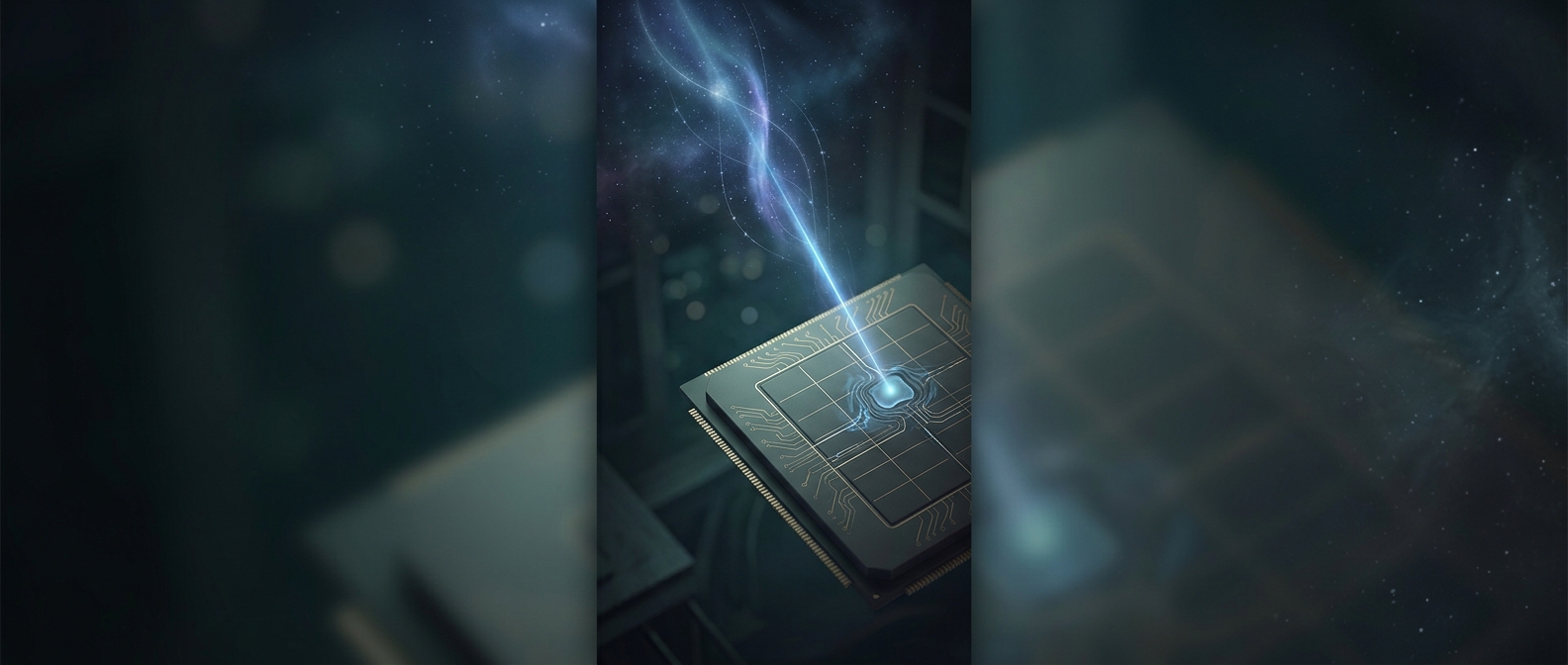
Many particles arriving from space do not reach a computer chip directly. When a high-energy cosmic ray hits the atmosphere, it can generate a shower of secondary particles, including neutrons. Some reach electronics at ground level and pass through a chip’s silicon.
A memory cell stores information as an electrical state. If a passing particle deposits enough charge in the cell, it can make the circuit read the opposite state. The particle does not need to damage the chip: it can leave the silicon intact while changing the data held in one bit.
How one changed bit becomes a system problem
A flipped bit may do nothing noticeable. It might alter a value that is quickly overwritten, or it might affect data the computer never uses. But if it changes a piece of active information—such as an instruction, a stored number, or a control value—the software may behave incorrectly. In a sensitive system, that can lead to a crash or a wrong result.
The risk is not limited to spaceflight. Earth’s atmosphere blocks much of the incoming radiation, but secondary particles can still reach computers on the ground. The chance of an upset varies with conditions such as altitude and with the design of the electronics.
Designing for errors, not just damage
Computer systems can detect or correct some memory errors by storing extra information alongside the data. Error-correcting memory can identify a changed bit and, in many cases, restore its intended value. Systems may also check memory repeatedly or use redundant components so one faulty reading does not dictate the outcome.
These safeguards matter because a chip can remain physically healthy while briefly holding the wrong information. A computer’s resilience depends not only on keeping hardware intact, but also on noticing when a tiny electrical disturbance has changed what the machine believes.