Building depth from a flat silhouette
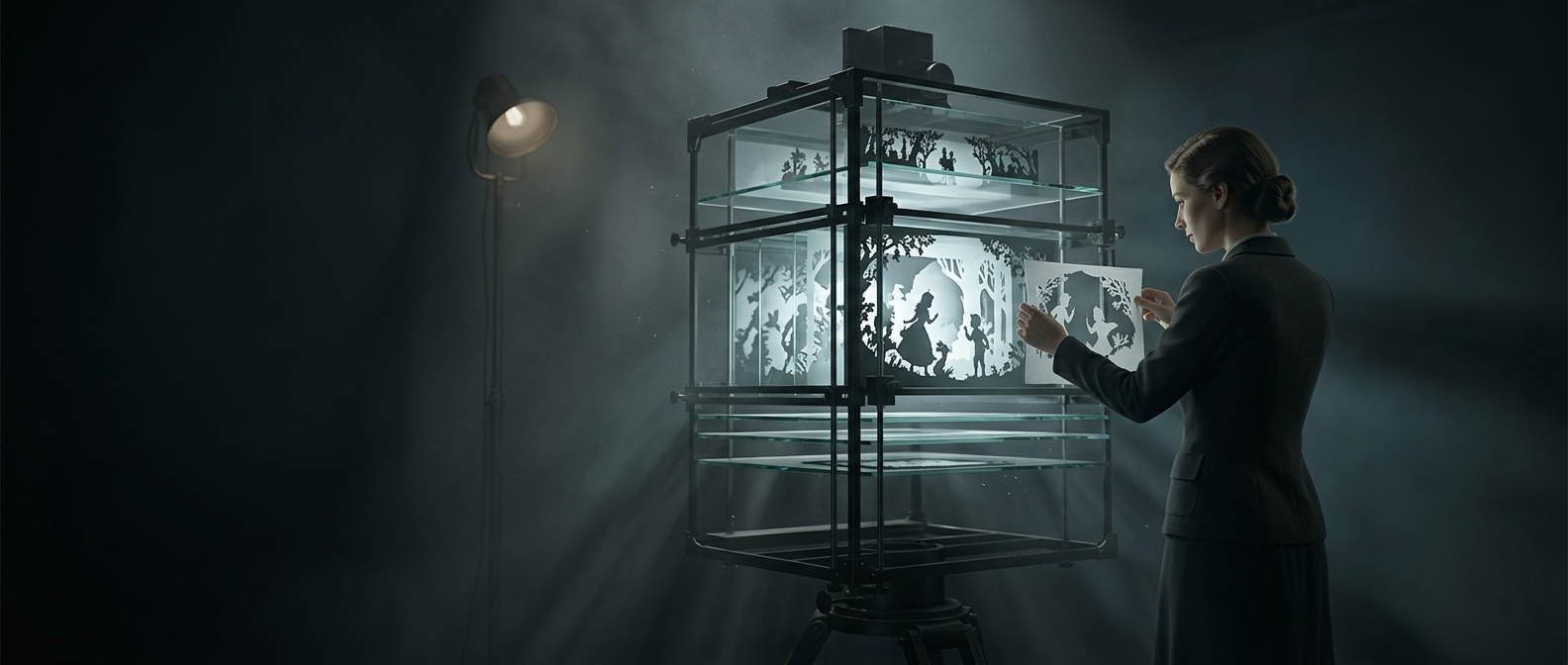
Lotte Reiniger’s animation table turned a simple arrangement into a miniature stage. She placed cutout figures on glass and set painted backgrounds on other glass planes, with space between them. Light shining up from below made the shapes read clearly against the scenery. Because the layers sat at different heights, the image gained a sense of foreground and distance instead of looking like one flat paper picture.
The figures were made to move at their joints. For each frame, Reiniger adjusted a character or object slightly, then photographed the arrangement from above. The next tiny adjustment produced the next frame. Played in sequence, those still images created motion—an intensely manual process in which even a brief gesture required many careful poses.
A stage made for shadow-play
The technique suited Reiniger’s storytelling. Her dark, sharply defined figures could be recognized by their outlines: a turn of the head, a sweeping sleeve, or a change in posture could carry the action without facial detail. The layered scenery added atmosphere and spatial cues while preserving the bold shadow-play effect.
Glass also imposed practical limits. Every layer had to stay aligned, and a stray shift could spoil the continuity between frames. The method did not create depth by itself; it made depth possible while demanding precise placement and painstaking control. Its memorable trick was to make a tabletop of cutouts feel like a world with distance—one frame at a time.