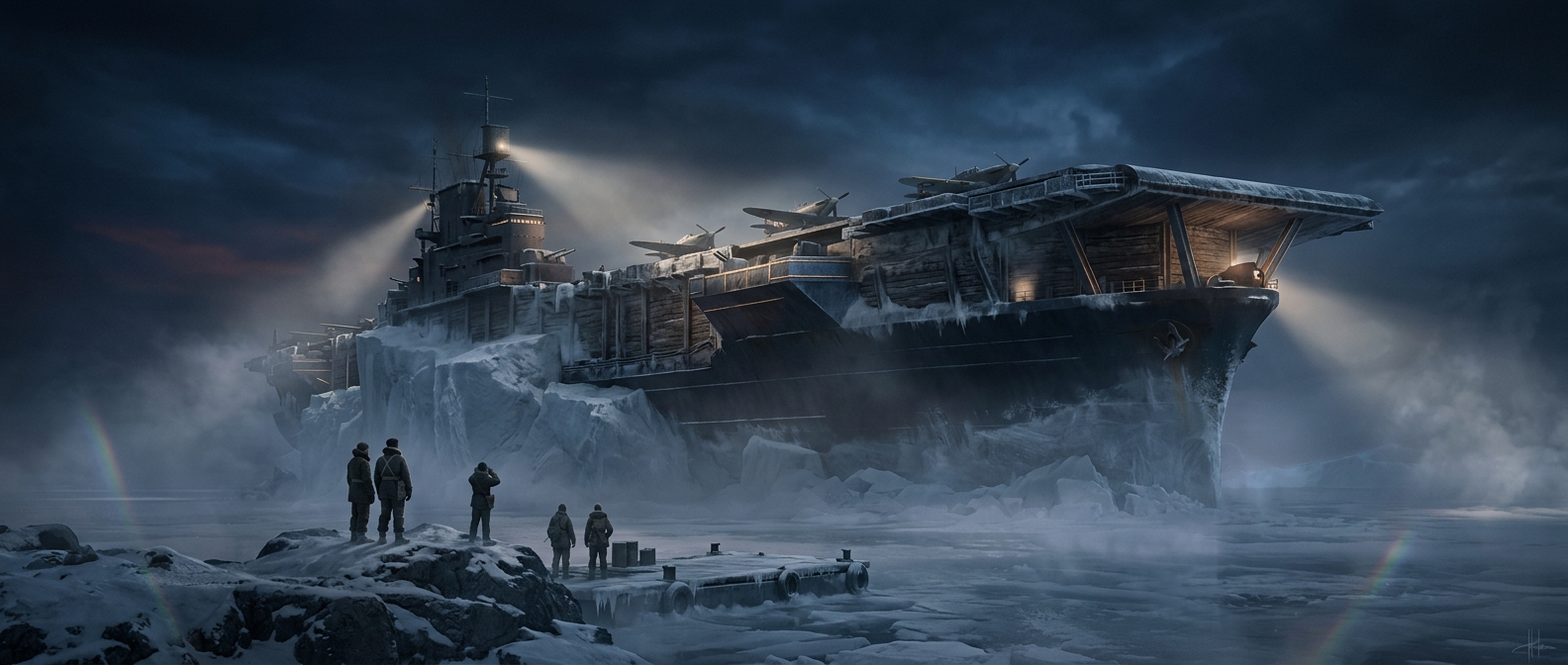
The Atlantic gap behind the ice-carrier idea
During World War II, German submarines threatened the supply ships crossing the Atlantic. Aircraft could help find and attack them, but conventional carriers were scarce, and land-based planes could not cover every stretch of ocean. British planners therefore explored an extraordinary workaround: build a huge floating airfield from pykrete, a mixture of ice and wood pulp.
The proposal, known as Project Habakkuk, was not simply to pile up frozen blocks. Pykrete could be formed into a strong structure, but a carrier would need a hull, propulsion, steering, and space for aircraft and their crews. The material offered a way to make an enormous platform from readily available ingredients; it did not make the rest of a ship disappear.
A material breakthrough met a ship-sized problem
Pykrete’s wood fibers helped hold the ice together and slowed its melting. That made it more promising than ordinary ice, but a full-size vessel would still absorb heat from seawater and air. It would need insulation and machinery to keep the structure cold—an ongoing engineering burden, not a one-time construction step.
A small experimental structure was built on Patricia Lake in Canada to test the material and refrigeration concept. It demonstrated that pykrete could be shaped and kept frozen on a modest scale. Scaling that success up to a 2,000-foot carrier, however, meant solving problems of cooling, construction, propulsion, and operation on a far larger scale.
Why the runway never sailed
The concept addressed a real wartime need, but its enormous size brought enormous logistical demands. Refrigeration alone could not turn a floating slab into a practical warship, and the project’s engineering and resource requirements became difficult to justify as the military situation and available options changed.
Habakkuk is remembered less as a ship that nearly launched than as a striking case of a clever material solving only one part of a system. The ice could be made tougher; keeping an iceberg-sized aircraft carrier usable at sea was the harder problem.