A world assembled from words
In early multiplayer fantasy games, a room might be described in a few sentences: a corridor ran north, a door stood to the east, and something moved in the shadows. Players entered commands such as “go north,” “look,” or “take key.” The game’s software interpreted each command, changed the shared world when appropriate, and sent back a new description.
Many of these environments were called MUDs, short for “multi-user dungeons” (and later, in some games, “multi-user dimensions”). “Multi-user” mattered: players could encounter one another in the same virtual place, talk, cooperate, or compete, even though each person saw the world as text on a terminal.
The limits shaped the play
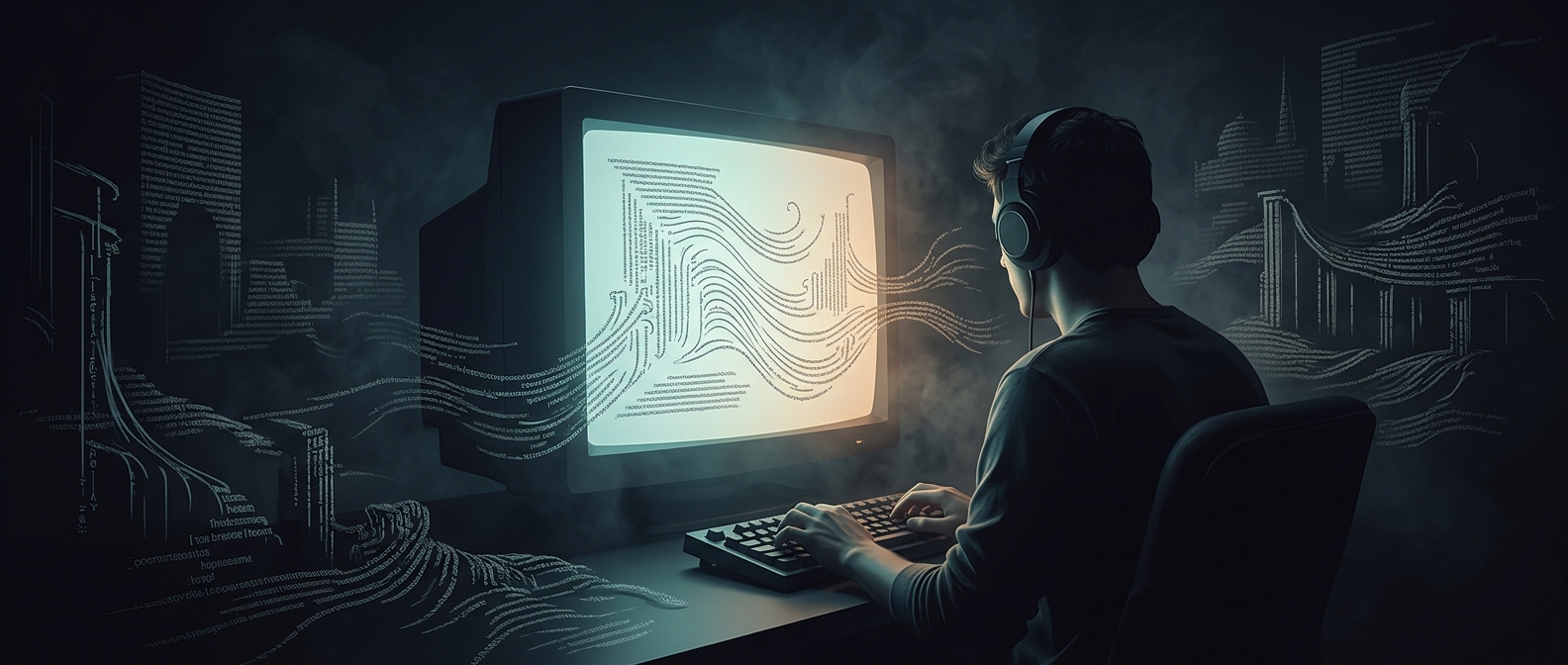
Text was not just a substitute for pictures. It let a game describe places, objects, and actions without needing to draw them on a player’s screen. That suited the terminals and network connections available to many early players, while leaving the central computer to keep track of the world and its occupants.
The tradeoff was that players had to infer space from language. A sentence about a locked gate could prompt exploration or a search for a key; a terse command parser might reject a phrase it did not recognize. Players learned the game’s vocabulary as well as its map, and a vivid scene depended on both the writer’s description and the reader’s imagination.
Because the world was shared, a message or encounter was also an event happening to other people, not merely a line in a solo story. A handful of typed words could therefore establish a place, suggest what to do next, and bring another player into the scene—work that later games could distribute across graphics, animation, and sound.