The Box Is a Stage, Not Just a Container
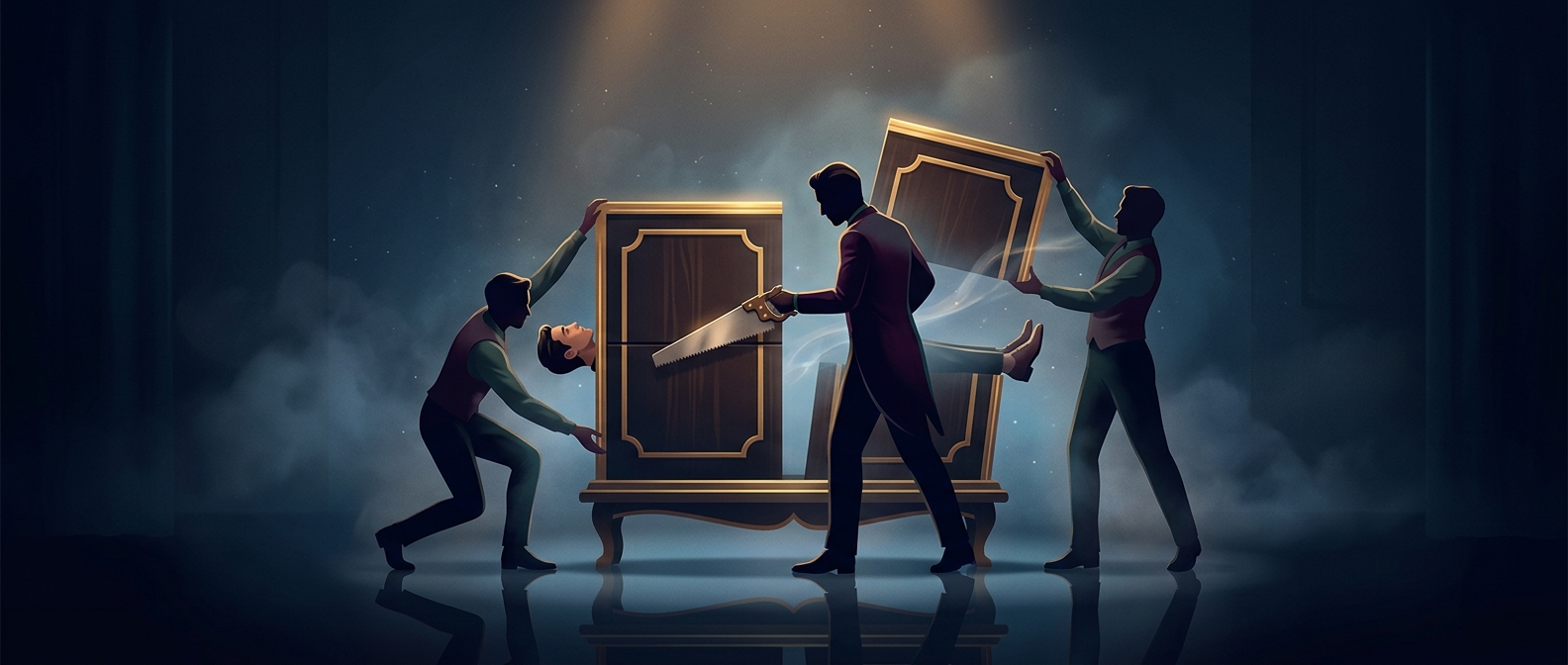
A sawing illusion works because the audience sees a persuasive outline of a person, not an uninterrupted view of the person’s body. The crate hides the very area where the trick must happen. Its panels, openings, and internal space are arranged to control what spectators can see while giving the assistant room to adopt a position that would be difficult to hold in an ordinary box.
There is no single construction used in every version. Some designs rely on concealed compartments or carefully positioned parts that resemble the assistant’s legs; others use different arrangements of the assistant and the box. The magician’s saw and the apparent separation sell the story, while the hidden geometry keeps the audience from checking the crucial space directly.
Suspense Comes From What the Audience Can’t Verify
The illusion is designed to reveal just enough: the assistant enters, the box closes, and the saw crosses it. Each visible action seems to confirm the danger, but the audience never gets a clear view of the body where the blade appears to pass. The magician controls that gap with the box, the performers’ positions, and the timing of what is shown.
That is why the assistant’s composure matters. A smile or a wave turns a frightening image into a playful performance—and gives spectators another detail to watch instead of studying the box. The trick’s memorable tension comes from seeing an apparently impossible cut while knowing that the most important part of the scene remains out of sight.