How a Painted Fortress Became Part of the Set
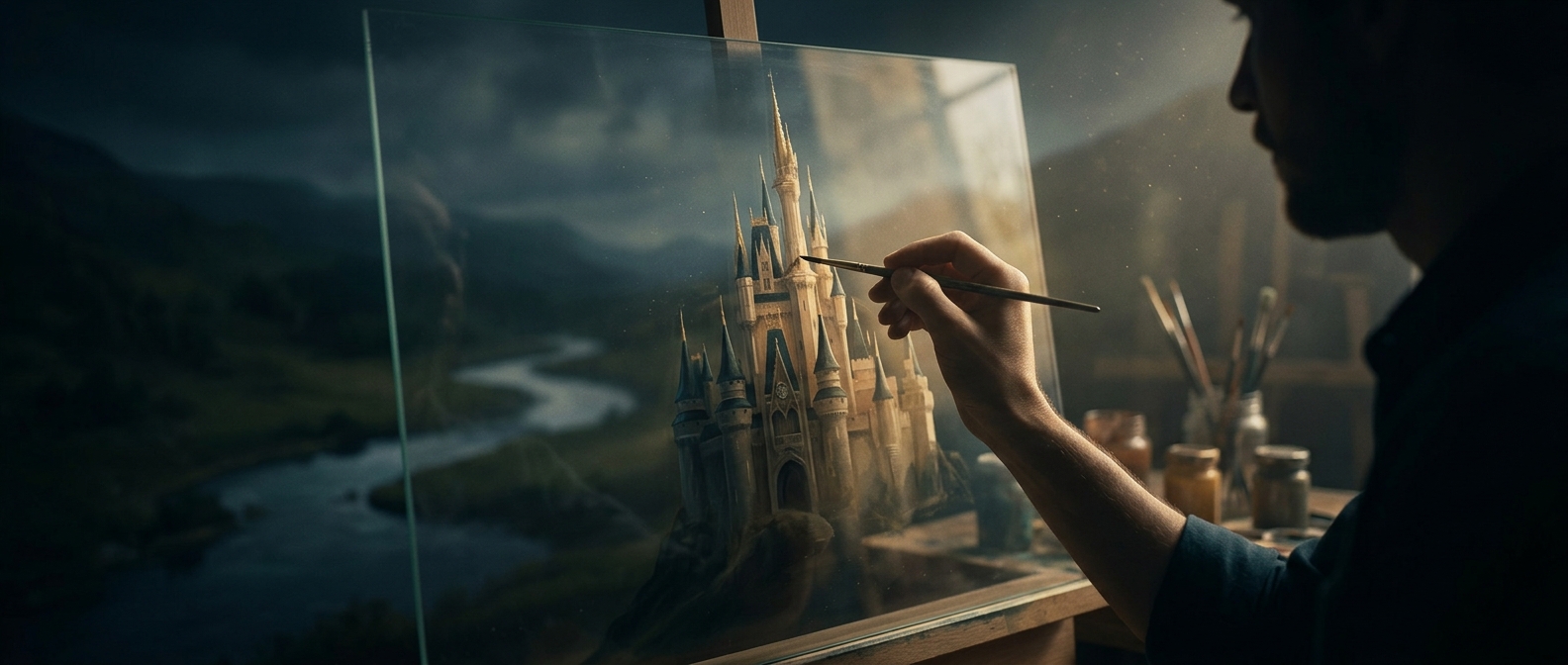
A glass painting worked by dividing the image between two things: the real scene and the painted one. Artists painted the parts a production did not need to build—such as distant walls, towers, or a dramatic skyline—onto a sheet of glass. They left clear areas where actors or practical scenery had to remain visible. Through the camera, the painted architecture filled the gaps and seemed to continue the physical set.
The trick depended on careful alignment. The glass had to sit at a chosen distance from the lens, and the painted lines had to match the camera’s view of the real scenery behind it. A tower that looked correctly scaled from the camera might appear oddly distorted to someone standing beside the glass; the painting was made for the lens, not for the room.
Why the Camera Had to Cooperate
This method was most convincing when the camera stayed still. If it moved, the real scenery shifted in perspective while the nearby painting did not shift in the same way. That mismatch—called parallax, the apparent change in an object’s position when viewed from different angles—could reveal that the fortress was painted.
So a glass painting let filmmakers suggest a vast setting without constructing every stone, but it also imposed a precise boundary: the illusion worked from the planned viewpoint. The towering castle existed fully only in the frame, where painted distance and real scenery could meet as one image.