How Kepler turned orbital motion into musical intervals
A planet does not move around the Sun at one steady speed. In its elliptical orbit, it travels faster when it is closer to the Sun and slower when it is farther away. Johannes Kepler treated those changing speeds as the raw material for a kind of mathematical music.
He compared each planet’s speed at different points in its orbit, then expressed the relationships as ratios. Ratios also describe musical intervals: for example, two pitches sound an octave apart when one vibrates twice as fast as the other. Kepler used this shared language of proportion to connect celestial motion with musical harmony.
A harmony written in numbers
Kepler’s idea was not that a planet made a note that ears could hear. Space does not carry sound from a moving planet to an observer. Instead, the “music” was a set of numerical relationships: orbital speeds could be represented by ratios, just as pitches can.
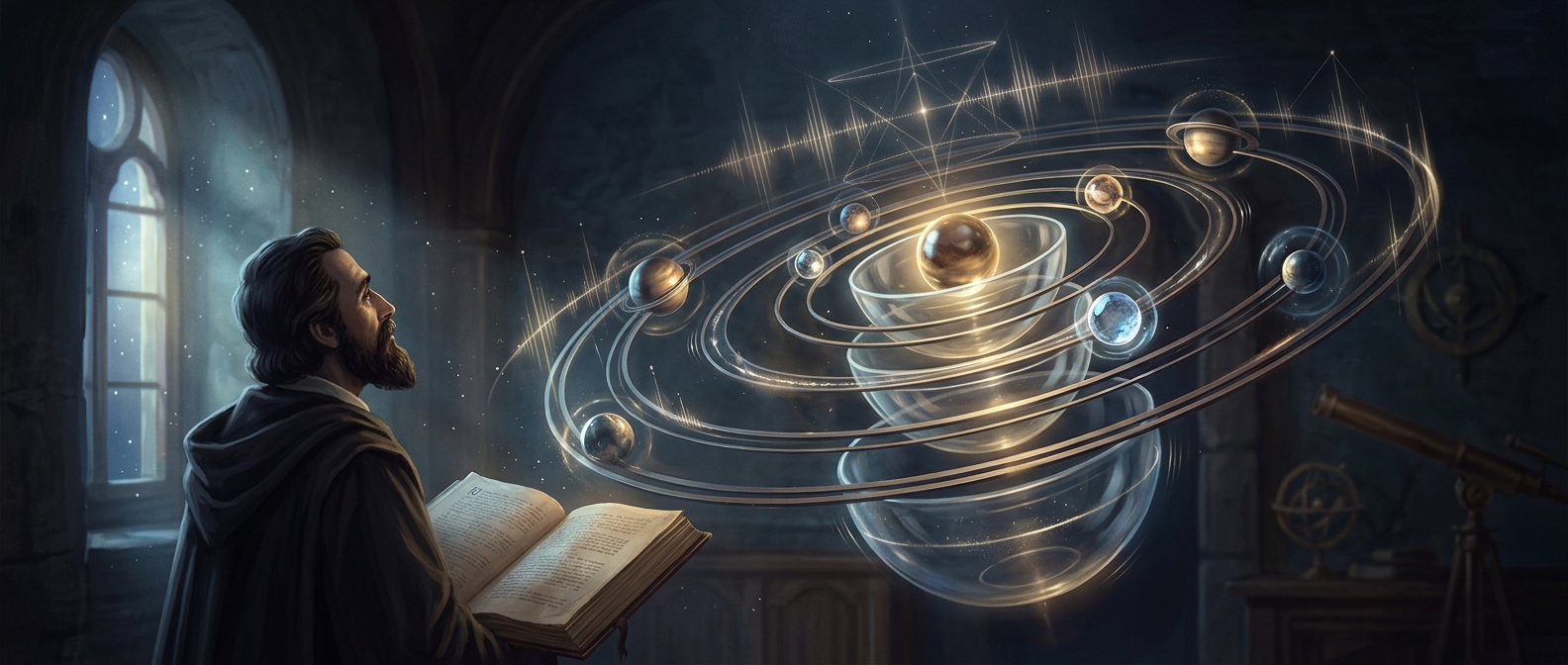
In his 1619 book Harmonices Mundi—“The Harmony of the World”—Kepler worked out these relationships for the known planets. He believed that the patterns revealed an underlying order in the cosmos, much as musical harmony revealed order in sound. His account combined mathematical reasoning with a philosophical conviction that the structure of the heavens should be harmonious.
The idea also depended on a real feature of planetary motion: speed changes across an orbit. A planet’s “part” in Kepler’s cosmic score was therefore not a single fixed note, but a range of values tied to where it was along its path. The melody existed as a pattern to calculate, not a performance to hear.