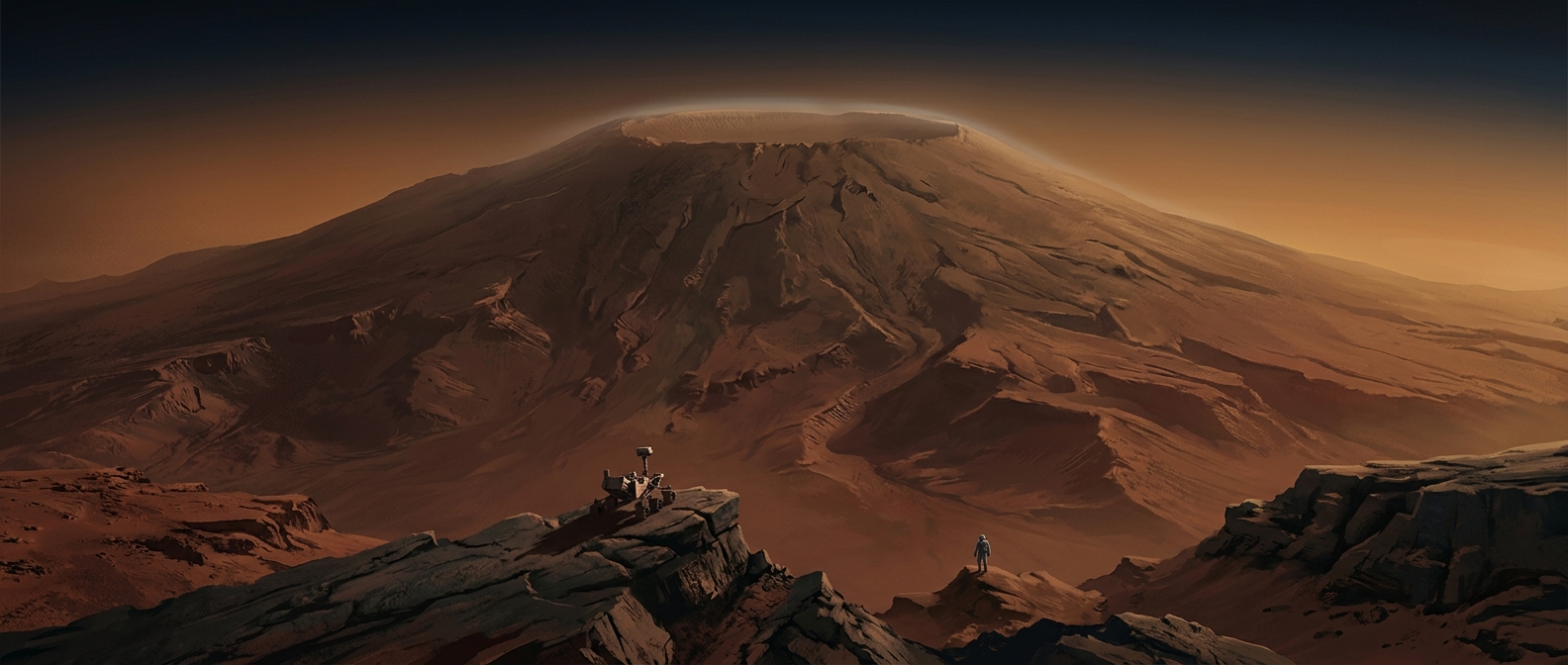
A volcano built in place
On Earth, the crust is divided into moving plates. A plate can carry a volcano away from the underground source of molten rock, so later eruptions may begin somewhere else. Mars lacks this kind of active plate motion. That let Olympus Mons keep growing over a long-lived supply of lava: eruption after eruption added new rock to roughly the same spot instead of scattering volcanoes along a moving track.
The lava itself helped determine the volcano’s shape. Basaltic lava—the relatively fluid kind common on rocky planets—can travel far before cooling. Each flow spread outward and hardened into a broad layer, extending the volcano’s base as well as raising its summit. The result is a shield volcano: a mountain with a wide footprint and slopes far gentler than those of a steep, explosive cone.
Why Mars could support such a giant
Mars’s lower gravity means its surface pulls downward less strongly than Earth’s does. That makes it easier for a volcano to build upward before its own weight becomes a limiting force. Combined with repeated eruptions at one location, the persistent lava source helped Olympus Mons reach a scale no Earth volcano matches.
Its immense size is therefore not the trace of one catastrophic blast. It records a patient construction process: fluid lava spreading, cooling, and being covered by more lava until a single volcanic pile dominated the landscape.