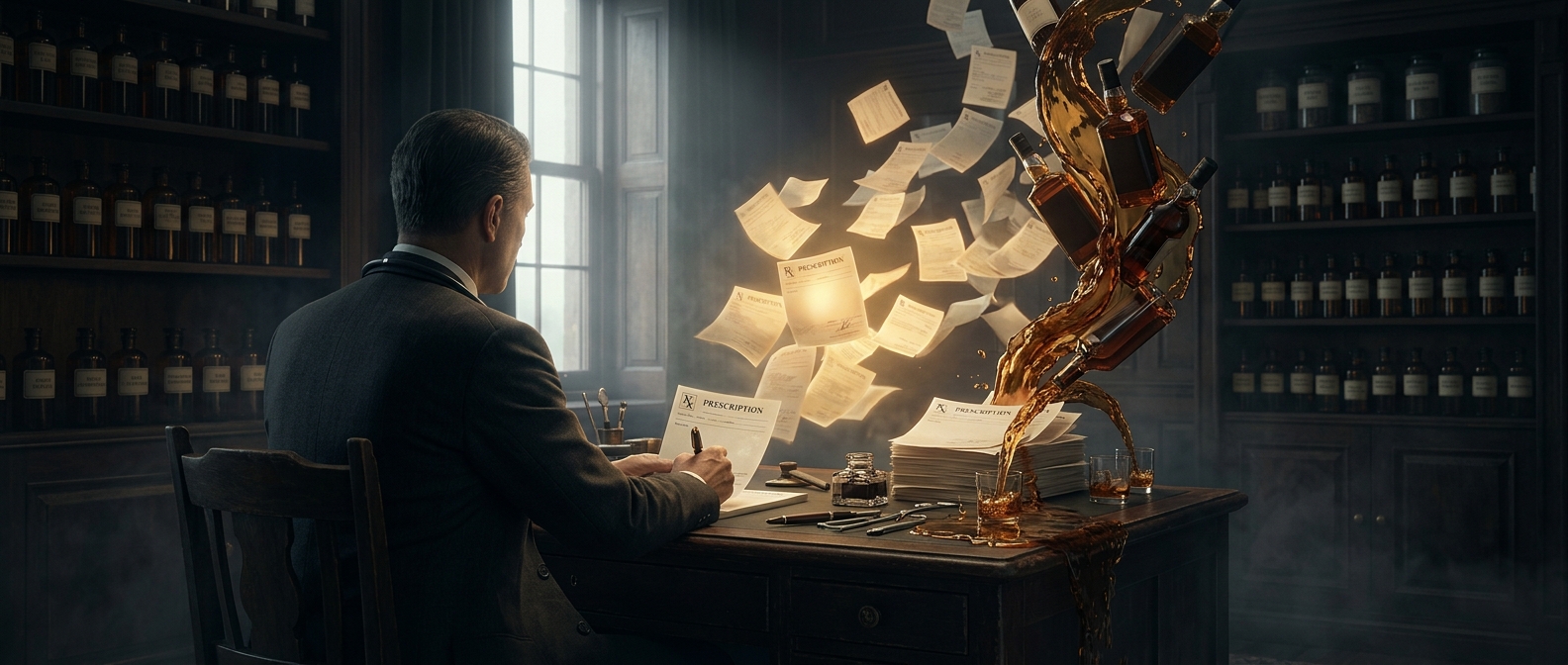
How a Prescription Became a Legal Route to Liquor
Prohibition barred the manufacture and sale of most alcoholic drinks, but the law did not treat every use of alcohol as illegal. It allowed physicians to prescribe it for medical purposes, and permitted pharmacies to dispense it. The exception turned a familiar medical ritual—a doctor’s signature followed by a trip to the pharmacy—into a lawful way to obtain a drink.
The prescription was not simply a note that any patient could take anywhere. Doctors and pharmacists had to operate within federal rules for dispensing alcohol. Whiskey was commonly supplied, in part because it was already regarded as a medicinal ingredient and could be stored and measured more easily than many other drinks.
When Medical Judgment Met Public Demand
The system depended on doctors deciding when alcohol counted as medicine. That left room for judgment: ailments were diagnosed and prescriptions written, while patients gained access to something that was otherwise difficult to buy legally. As prescriptions grew more common, the boundary between treatment and drinking became harder to distinguish.
Pharmacies, rather than ordinary saloons, became the point of sale. That did not make them bars in the formal sense; they were dispensing alcohol under a medical exception. But to a customer seeking a legal drink, the practical difference could be small. Prohibition restricted alcohol without eliminating the institutions capable of supplying it.
The loophole exposed a basic weakness in the policy: a ban could control ordinary commerce, yet still rely on private medical decisions to define legitimate use. The more those decisions were stretched, the more the pharmacy counter resembled a respectable substitute for the saloon.