Two calendars gave each day a paired name
Maya daykeeping used two cycles side by side. The Tzolk’in counted 260 days by combining 13 numbers with 20 day names. The Haab’ tracked a 365-day year: 18 months of 20 days, followed by a short period of five days. Each date could therefore be identified by a Tzolk’in date and a Haab’ date together.
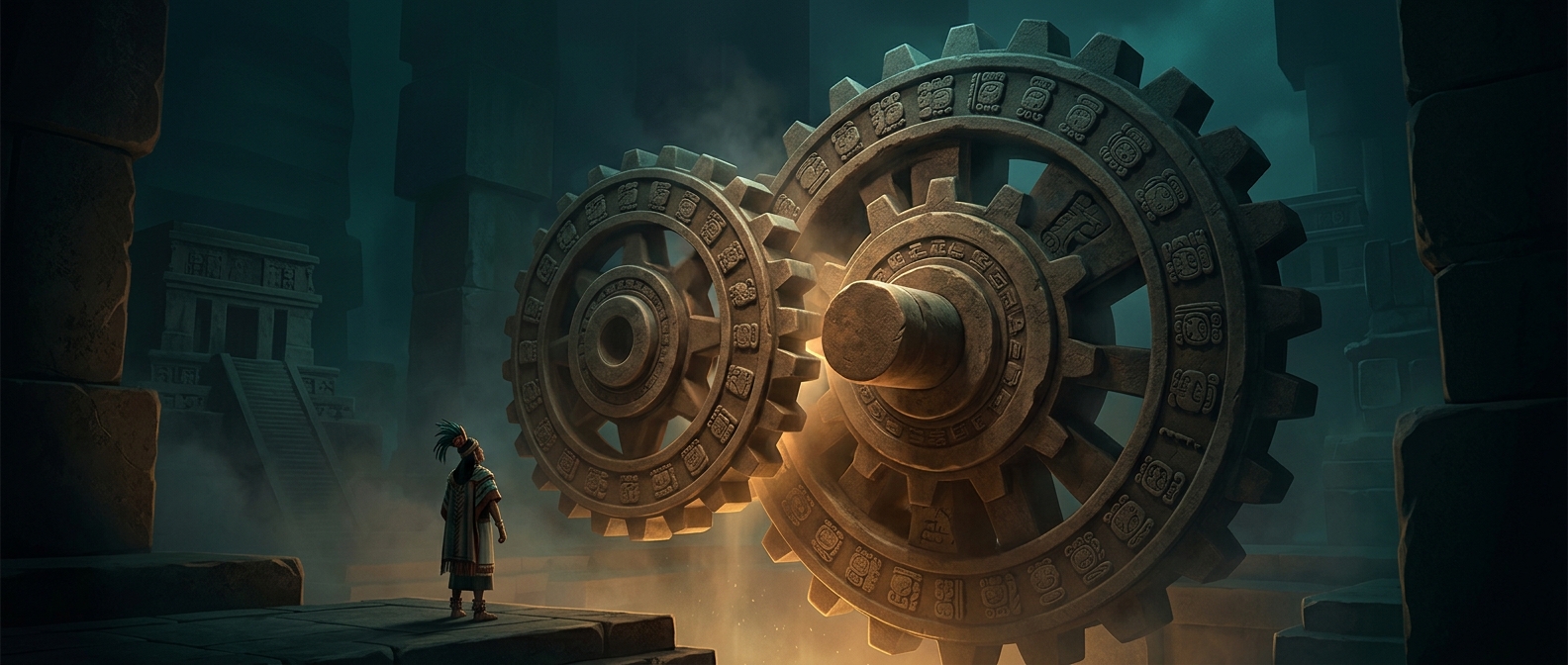
A single cycle’s label was not enough to identify a day uniquely. The Tzolk’in sequence repeated after 260 days, while the Haab’ date returned after 365. But their combination kept changing as the cycles moved against each other.
The pairing took 52 years to come around again
The same pair returned after 18,980 days—the first point at which both cycles had completed a whole number of turns. That span equals 73 Tzolk’in cycles and 52 Haab’ years, so a date pairing could recur after 52 calendar years.
Those were 365-day years, not 52 exact solar years: the Haab’ calendar did not add a leap day to keep pace with the seasons. The repeating span, often called the Calendar Round, was useful for placing a date within that cycle, but it could not by itself distinguish between two occurrences separated by a full round.
For dates that needed a longer historical position, Maya scribes could also use the Long Count, a count of days from a starting point. Together, the systems worked at different scales: the paired cycles identified a day within a repeating 52-year pattern, while the Long Count could distinguish one such pattern from another.