How a cellar press became a machine for making books
A wine or beer press had a simple but demanding job: squeeze a large mass evenly enough to extract liquid without wasting force. One useful solution was a screw—a threaded rod turned by a handle. As it descended, it pushed a broad plate, or platen, down onto the material. The screw converted a person’s turning motion into strong, controlled pressure.
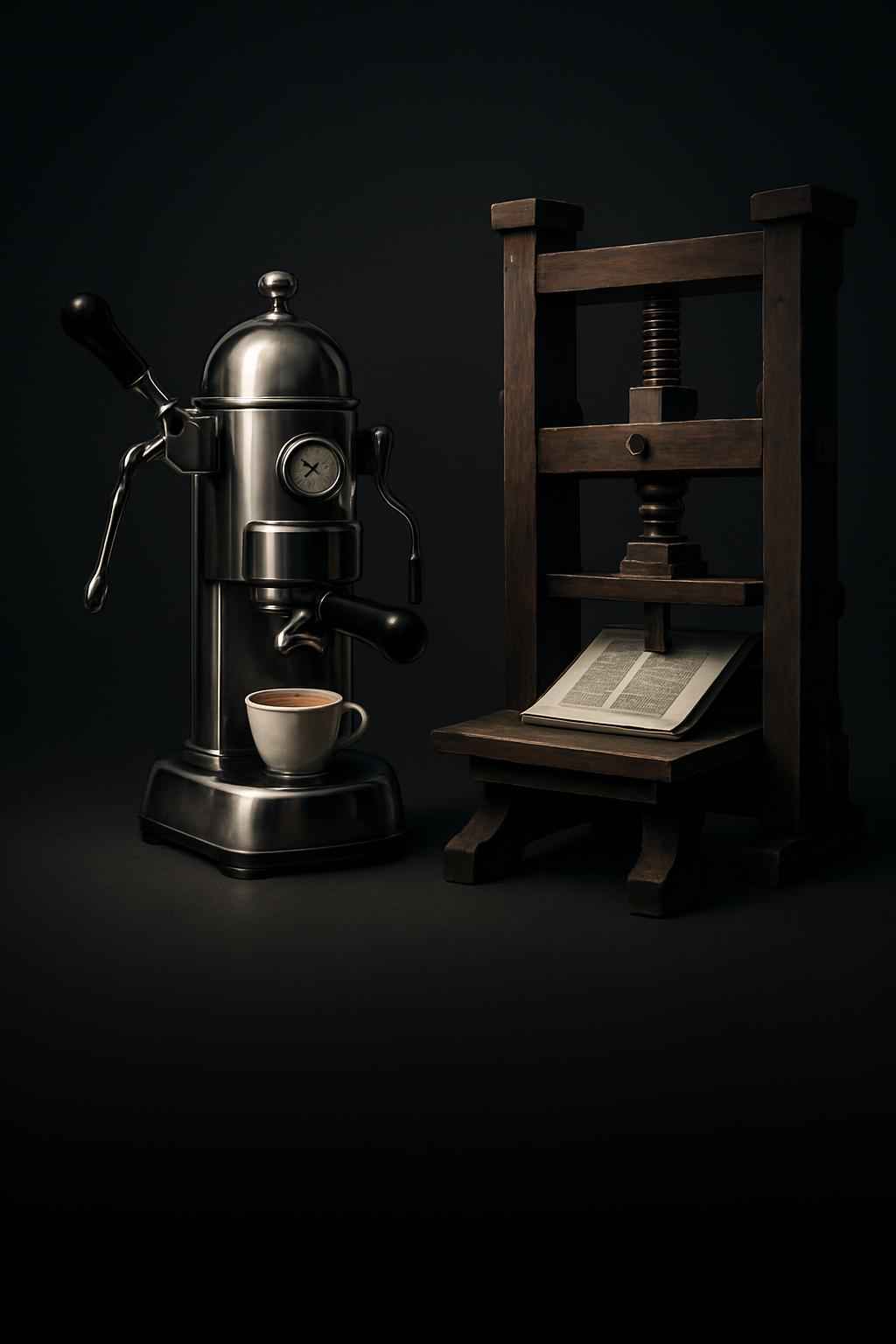
That arrangement also suited printing. In a hand-operated printing press, a worker placed inked type and paper beneath a platen, then used a screw mechanism to press them together. Even contact mattered: pressure had to transfer the raised letters’ ink to the page clearly, rather than leave some areas faint and others crushed. The press made it possible to apply force repeatedly and predictably, one sheet at a time.
Pressure outlasted the original job
The lasting contribution was not one particular machine but a way to manage force: concentrate it, control it, and spread it over a working surface. Presses could be adapted wherever materials needed to be squeezed, shaped, or brought into firm contact. The principle travelled farther than the cellar, even as later machines used different mechanisms to generate pressure.
An espresso machine, for example, does not simply reproduce a medieval screw press. It forces hot water through compacted coffee using pressure created by its own heating or pumping system. The shared idea is more basic: a machine can make pressure do useful work that hands alone could not deliver as steadily. From a platen pressing paper to water moving through coffee grounds, controlled force turns a difficult manual task into a repeatable process.